
 Written by:
With so much choice on the market, it can be hard to choose play equipment for dogs! Dogs see certain colors (blues and yellows) well, detect motion, and have better night vision than we do. Understanding your dog‘s vision can help you make decisions that will enhance your dog’s play experience, while also improving training and performance.
Understanding Dog Vision
There are some key differences between human vision and a dog’s vision. It’s important to understand these differences, since they mean your dog sees the world differently than you.
Here are some key facts to understand about your dog’s vision:
Color Vision
Dogs are dichromatic, whereas humans are trichromatic. This means dogs have only two types of cones, while people have three.
Cones are photoreceptor cells found in the retina, at the back of the eye. The retina detects light, processes the information, and transmits signals to the brain. The cones are the cells of the retina responsible for differentiating color.
Having one less type of cone means it is hard for dogs to distinguish red and green (similar to red-green color blindness in humans). Despite this, some studies have shown that dogs may use color more than brightness when choosing between different stimuli.
Studies so far suggest that dogs can see yellow and blue clearly. While they can appreciate different brightness levels, studies suggest that brightness discrimination in dogs is worse than in humans.
Field of Vision
Dogs’ eyes sit on the sides of their heads, giving them a wide field of vision (approximately 150° to 240° depending on breed, compared with around 180° in people).
Dogs vary greatly in height between breeds, so eye level varies too!
Clarity of Vision
In daylight, dogs don’t have vision as clear as ours. They need to be much closer to an object in order to see it clearly. They can see objects from a distance, but they will appear blurred. Most dogs would need to be only 20 feet away from an object that a human could see clearly from 75 feet away. The upside is that they detect motion much better.
Night Vision
Dogs have very good night vision (much better than humans), owing to the fact that they have more rods (photoreceptor cells in the retina that detect light levels and enable vision in dim light). They also have a ‘tapetum lucidum’, which is a reflective membrane behind the retina. It reflects light back to the retina.
Age-Related Changes
A dog’s vision can decline with age, so it’s important to take age (or any health issues that may affect vision) into account when trying to understand your dog’s vision.
While these facts about canine vision are fascinating, you can also apply them to everyday life. For example, understanding your dog’s vision can help you choose the best toys and training equipment.
How Understanding Dog Vision Helps You Choose Toys and Training Tools
When choosing toys, training tools, or agility equipment, it’s important to picture the world as your dog sees it (not as you do).
Best Colors for Fetch Toys
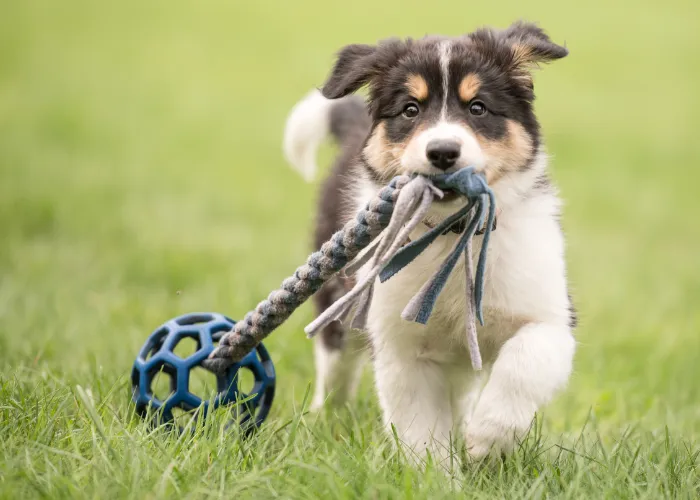
Consider your dog’s reduced color vision when choosing toys, especially toys designed for fetching! You may think the red toy looks like great fun, but your dog may struggle to distinguish red from green, making it hard to find the toy in a green grassy field. Yellow and blue toys tend to be the easiest for dogs to find, since they can see those colors clearly.
Choosing Visible Agility Equipment
Using your knowledge of dog vision to choose agility equipment can make training easier, increase your dog’s enjoyment of agility, and improve their performance.
Blue and yellow are obvious color choices for agility equipment. However, contrast matters, too. For example, red equipment on green grass will not be easily visible to your dog. Strong black-and-white contrast will be more obvious.
Consider using blue, yellow, or back/white combinations on key parts such as crossbars, tires, and weave poles. This helps your dog see them better, enabling them to judge distances, angles, and trajectories.
Making Outdoor Play Easier for Your Dog
You can also use your knowledge of a dog’s vision when playing with your dog, training them, or practicing agility outdoors. Here are 5 top tips:
- Consider your dog’s field of vision when choosing where to stand in relation to them.
- Use blues, yellows, and white/black contrast when choosing toys and play equipment, so your dog can spot them easily against a green lawn or artificial grass.
- Using blues, yellows, and white/black contrast for treat bags can help your dog focus when your hand moves to the treat pouch.
- If you are training your dog using hand gestures, you could consider wearing a blue or yellow glove to make your hand more easily visible.
- Static hand signals won’t be as effective at a distance, due to your dog’s poor visual clarity at long range. Consider using auditory cues at the same time, or incorporating motion into the hand signal (since dogs are excellent at detecting motion).
When considering outdoor play more generally, remember that dogs need to use all of their senses for mental stimulation! In fact, some studies have shown that the part of a dog’s brain processing smell is directly connected to the part of the brain processing vision. So, their senses work together to create their experience of the world.
You could consider having a dog’s sensory garden section. Try planting different dog-friendly herbs, such as rosemary, lavender and lemon balm. Your dog will love smelling (and possibly tasting) these! Try planting them in separate sections, so the scents don’t mix and cause sensory overload. You could also try planting some dog-friendly blue and yellow flowers, such as pansies, as your dog may find these visually appealing.
Dogs also love to explore and dig! Leaving an area of earth unplanted, or providing a sand pit for them to dig in, will provide plenty of mental and physical stimulation. Remember to leave some more shaded areas too, with fresh water down, so your dog can relax and cool off when needed.
So, dogs appear to see fewer colors than we can, with reduced visual acuity and increased sensitivity to bright light. However, they are good at discriminating between blue and yellow hues, have better motion detection, and superior night vision. Understanding these differences means that you can adapt their play, toys, and environment to best suit their vision, as opposed to yours. This will not only improve their overall welfare, but can improve training success and strengthen your bond.




Leave a Comment