
 Medically reviewed by:
  Legally reviewed by:
 A Psychiatric Service Dog (PSD) is a type of assistance dog that helps people manage mental health conditions by performing trained tasks. PSDs have full public access rights under federal and state laws, including entry to restaurants, stores, housing, and airplanes. After reading this guide, you will understand who qualifies for a PSD, what tasks these dogs perform for mental health support, how to get and train a PSD, and the legal rights and protections you have as a handler.
What is a Psychiatric Service Dog?
A Psychiatric Service Dog is a service animal trained to support your mental health. Just like service dogs trained for physical disabilities, PSDs are protected by laws that ensure their acceptance in public places. PSDs are different from emotional support animals (ESAs) because they are needed to perform a task for their handler both inside and outside the home.
By law, Psychiatric Service Dogs are permitted in public areas where ordinary pets are disallowed. This includes on airplanes. You will need to complete a DOT Service Animal Air Transportation Form to do so.
Who qualifies for a Psychiatric Service Dog?
You can qualify for a Psychiatric Service Dog if you have a disability (a physical or mental impairment that substantially limits one or more major life activities).
What is a psychiatric disability?
A psychiatric disability is a mental or emotional impairment that affects one or more major life activities. Only a licensed medical professional can diagnose you with a disability and assess whether or not a service animal will mitigate one or more symptoms of your disability.
PSD Training Requirements
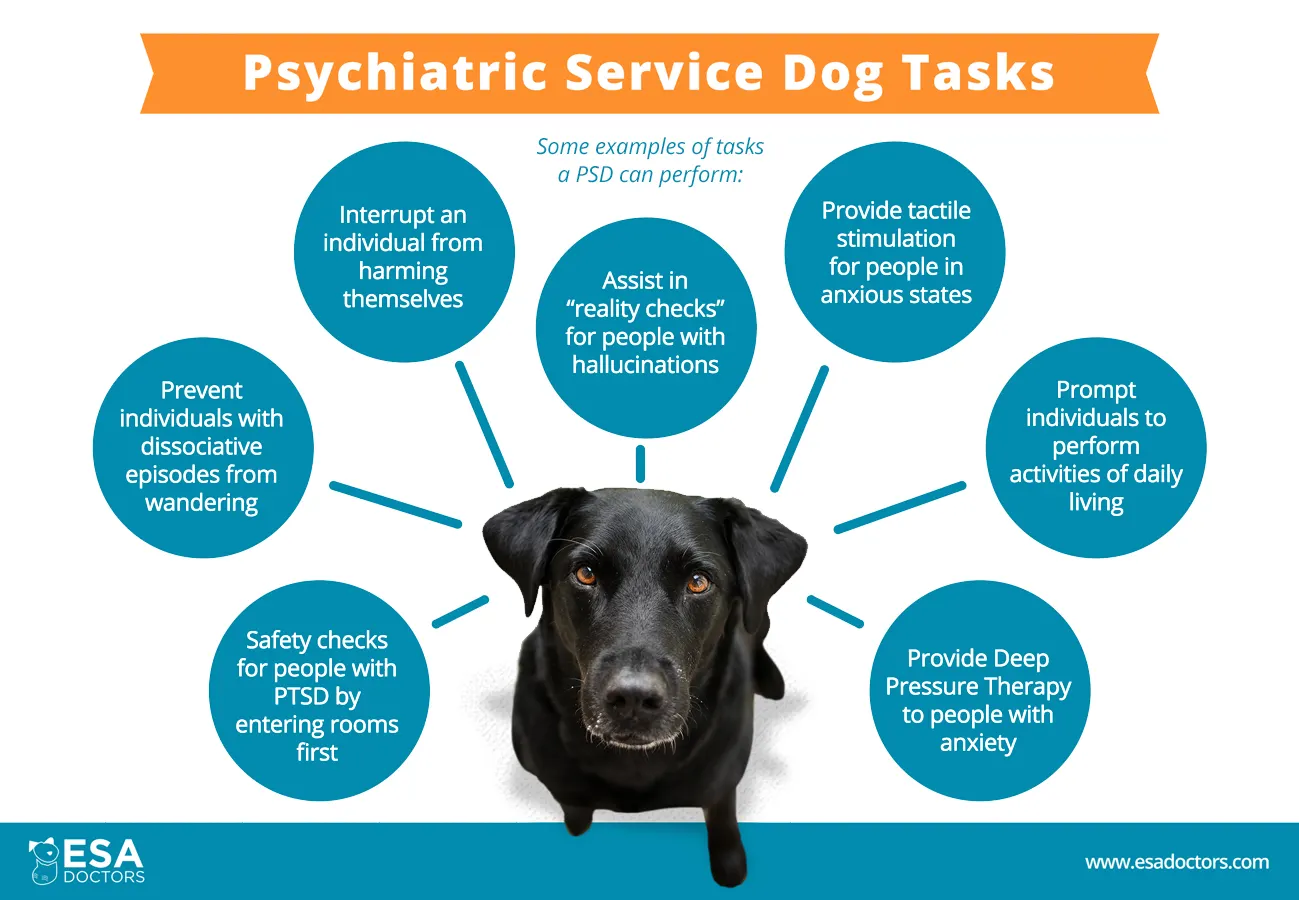
A PSD must learn specific work or tasks that help you manage your mental health condition. For example, a PSD might:
- Wake you during nightmares
- Guide you to exits during panic attacks
- Alert you to take medication
- Interrupt self-harming behaviors
- Apply deep pressure therapy
Beyond these tasks, your PSD needs solid public access training. This means staying calm and focused on you in challenging environments like:
- Busy restaurants
- Crowded stores
- Public transit
- Medical appointments
- Movie theaters
Psychiatric Service Dog Tasks
Psychiatric Service Dogs can be trained to perform a variety of tasks for their handlers. You can train your PSD yourself or work with a professional trainer, both are legal under the ADA. Self-training works well if your dog already naturally responds to symptoms of your disability. Some dogs naturally lick or paw at their owner when he/she is crying or hyperventilating during a panic attack. However, some handlers find professional training helpful, especially for complex tasks or public access work. Keep in mind, professional training is not required to have your dog designated as a PSD or service dog.
Legal Rights of Psychiatric Service Dogs
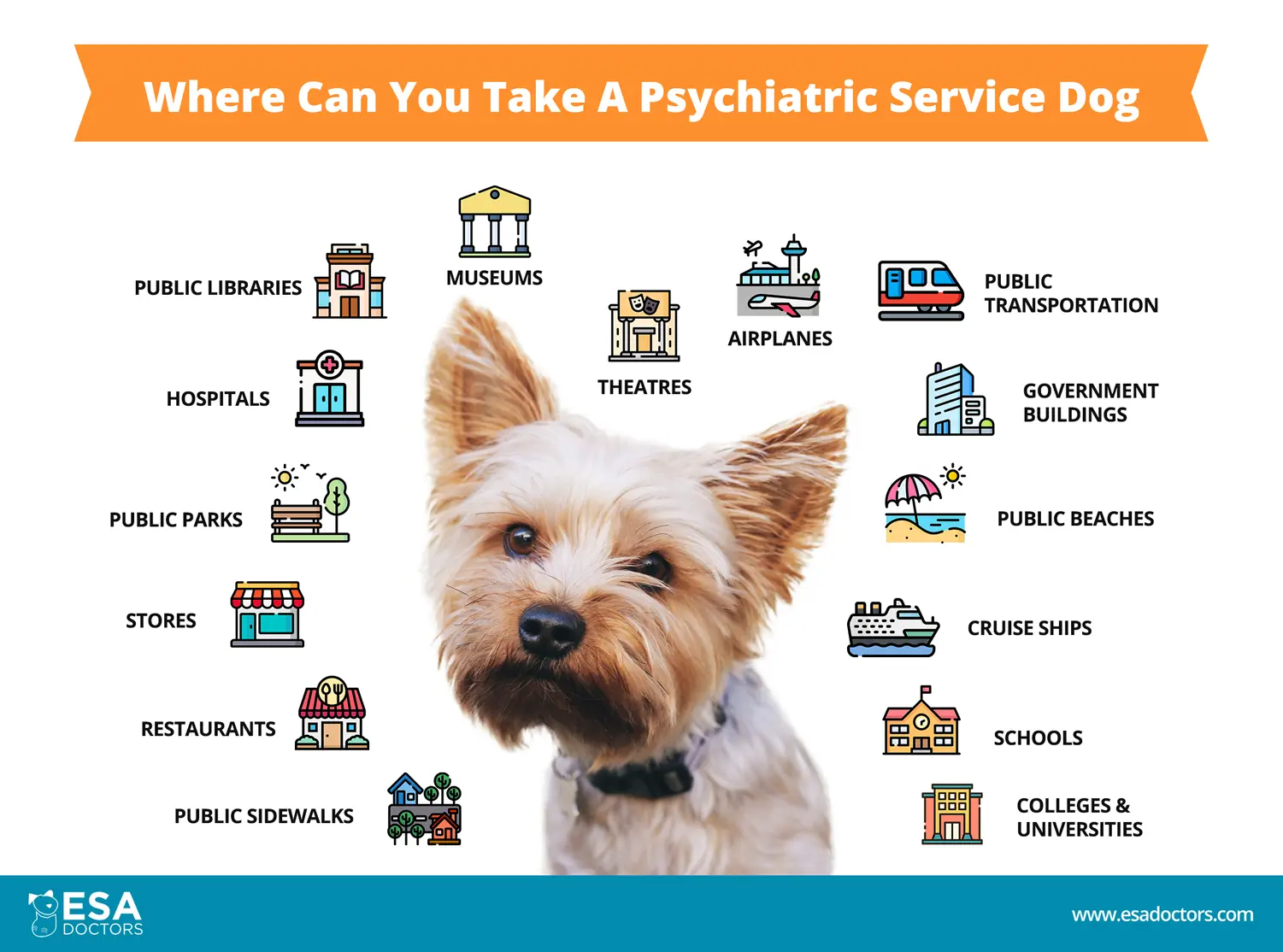
Psychiatric Service Dogs have extensive legal protections under U.S. federal law. Under the Americans with Disabilities Act (ADA), Fair Housing Act (FHA), and Air Carrier Access Act (ACAA), you can take a Psychiatric Service Dog to places that normally don’t allow dogs.
Your PSD can accompany you in places like:
- Restaurants and grocery stores
- Hotels and vacation rentals
- Beaches and parks
- Public transportation
- Airplanes and airports
Psychiatric service dogs also have housing rights. Most landlords are obligated to do the following:
- Accept your PSD regardless of “no pets” policies
- Waive all pet fees and deposits
- Allow PSDs of any breed or size
- Make reasonable accommodations for your service dog
Businesses, public venues, and landlords that violate these service dog rights can face legal consequences and fines not only under federal law.
Flying with a Psychiatric Service Dog
Air travel regulations grant PSDs the right to board planes with their handler without any additional charges. To enjoy this benefit, PSD handlers just need to submit the DOT Form and PSD Letter to the airline ahead of time.
We also recommend having other service dog accessories, such as a harness, vest, tag, and PSD letter, while you’re at the airport, so staff and other passengers can easily recognize that you have a service dog and not a normal pet. While these items are not required by law and by themselves carry no legal protections, it is often a quick and easy way to have your PSD identified as a service dog and not a normal pet. Pets are subject to heavy restrictions and fees, so it’s important for staff to be fully aware that you’re traveling with a PSD.
How to Validate a Psychiatric Service Dog
If you are in a public place or an establishment and someone wants to verify that you have a Psychiatric Service Dog, they are legally allowed to ask only two questions:
- Is the dog a Psychiatric Service Dog required because of a disability?
- What work or task has the PSD been trained to perform?
The law does not permit inquiring about the specifics of the handler’s disability, demanding to see the PSD perform its task, or asking for identification or certification as proof of the service dog. As a Psychiatric Service Dog owner, you have a right to privacy and dignity. Third parties have to limit themselves to the two questions above and can’t interrogate you about your health status.
Can my emotional support animal become a Psychiatric Service Dog?
You can train a service dog on your own with consistent routine, patience, and discipline. Training your ESA to become a Psychiatric Service Dog does not require professional training or certification by an organization. While there are organizations and professional trainers available that can help with training, the ADA allows handlers to do the training themselves.
However, if you’re inexperienced with dog training or get stuck when training your dog, calling on the help of a professional is well advised.
Keep in mind there is also no official certification process for the completion of training for Psychiatric Service Dogs, but there are organizations that promote unofficial guidelines and standards. Your dog is not considered a full-fledged service dog until it can reliably perform its special tasks in all types of public environments.
Whether your emotional support dog can potentially become a Psychiatric Service Dog depends on several factors, including the following:
- Temperament: Your dog needs to be calm, focused, and able to work in public settings without being distracted or reactive to other people, animals, or environmental stimuli.
- Trainability: Your dog must be capable of learning and reliably performing specific tasks related to your disability.
- Physical Capability: The dog needs to be physically able to perform the required tasks. Consider your specific needs. Ff you need the dog to perform body-positioning tasks, they need to be the appropriate size and strength.
- Health: The dog should be in good health without any chronic conditions that could interfere with their work.
- Current Behavior: If your ESA already shows anxiety, aggression, or strong prey drive, they might not be suitable for service work.
- Sociability: PSDs work in public environments, so they need to get along well with other humans and animals.
How to Make Your ESA Into a Psychiatric Service Dog
It’s possible to turn your Emotional Support Dog into a Psychiatric Service Dog if you’re willing to put in the work to train your dog, and your health condition requires a dog to perform specialized tasks. As a PSD owner, you get additional rights above the housing benefits ESAs have, including air travel and ADA rights that let you bring your dog to public places.
Here are the steps to turn your ESA into a Psychiatric Service Dog:
- Confirm you need your ESA to perform trained tasks
Both service dog owners and ESA owners have disabilities, but service dog owners need their dogs to perform a task relating to their condition both inside and outside of the home.
- Request Documentation
Work with a therapist or medical provider to obtain proper documentation – PSD Letter
- Train your dog
Train your dog by yourself or with the help of a professional trainer to perform a task that directly assists with your condition.
- Test your service dog’s manners
Make sure your dog can be calm, alert, and well-behaved in various busy public settings, like airports and stores.
- Optional: Get service dog accessories
You can optionally outfit your dog with vests, tags, harnesses, and ID cards to signal that your dog is an on-duty service dog. This is not required by law, but often makes it easier for service dogs and their handlers to be instantly recognized.
See if you qualify for a Psychiatric Service Dog.
Work with a licensed medical professional today!
Get your Psychiatric Service Dog Letter Now



How do I get a psd certificate for my doctor to validate for me? I can’t afford $200.00 when my own doctor knows me best and can fill it out for free.
You don’t need a certificate for a psychiatric service dog. You can ask for a PSD letter if that’s what you meant. A doctor or therapist can provide one for you.