

 Legally reviewed by:
  Medically reviewed by:
 If you’re not sure how to ask your doctor for emotional support animal documentation, you’re not alone. The conversation is hard because talking about your mental health is vulnerable, and many doctors genuinely want to help but don’t know how. This step-by-step guide, written and vetted by ESA legal experts and healthcare experts, covers what to say and how to handle the questions your doctor is likely to ask along the way.
Step 1: Explain to Your Doctor What an ESA Is
Despite the popularity of emotional support animals, many doctors are still not aware of what they are and how they can help. If this is your doctor, it’s best to start the conversation by giving them some background on what exactly an ESA is.
In a nutshell, an emotional support animal is a pet, usually a dog or cat, that improves your mental health. They can be any size and breed, and don’t need any special training or certifications. Unlike service dogs, which undergo specialized training, emotional support animals do their jobs just by being present in your life and responding to a symptom of your disability. They’re essential companions in the lives of people who have conditions like depression, anxiety, PTSD, or autism.
To prove you have an emotional support animal, you need supporting documentation from a licensed healthcare professional. This is where your doctor comes in. Once you have ESA documentation, you have legal protections, like the ability to live in “no-pets” housing.
Step 2: Explain How Your Pet Helps You
To qualify for an Emotional Support Animal under Federal and state guidelines, your doctor or therapist must determine two things. First, they’ll need to know whether you have a mental health condition that substantially limits major life activities. In simple terms, that means your depression, anxiety, or PTSD, for example, is so severe that it affects your ability to do essential things like work, study, or sleep.
Next, your doctor will need to confirm that an ESA helps your condition. This is where you’ll explain to your doctor, or therapist, how your ESA makes you feel better. For example, your dog might ease your depression by waking you up in the morning and alerting you to your morning routine. Or your cats can sit on your chest to provide pressure therapy when a panic attack is creeping up.
Step 3: Explain Why You Need ESA Documentation From Them
The reason you need to talk to a licensed health professional about your need for an ESA is because they’re the only ones who can provide ESA documentation. ESA documentation is the only way to prove under Federal and state laws that your dog or cat is not just a regular pet, but an assistance animal that is necessary for your mental health.
This is essential if you want your pet to be protected under federal housing rights law, and is extra important if you rent your home or live in a co-op or HOA where your landlord can ban pets or require approval. The professionals we work with understands the value ESAs bring to their owners. They will work with you through online evaluations.
Step 4: Explain the Benefits of Having ESA Documentation
At this point, your doctor might understand why you’ve asked them for ESA documentation, but not how documentation will benefit you. You can explain to your doctor that having ESA documentation ensures that your support animal will always be able to live with you, something that is not guaranteed without it. That’s because under Federal and state guidelines, landlords are required to accommodate ESAs even if they have a no-pets policy. ESA owners are also exempt from:
- breed restrictions
- weight and size limits
- pet fees and pet deposits
ESA documentation exempts tenants from most pet rules. That includes breed and weight restrictions, as well as the obligation to pay pet fees or pet deposits depending on the reasonableness of the fees and your financial situation. ESA documentation serves as a shield, protecting you and your support animal from eviction and burdensome financial costs. Having an ESA letter relieves a lot of anxiety for ESA owners who are fearful they could lose their ESA due to changes in housing circumstances one day, and that’s exactly what ESA laws were designed to protect against.
Step 5: Explain What You Need in the ESA Letter
If your doctor is now fully on board with giving you ESA documentation, great! But you might run into one caveat: they might not know how to write something up. If that’s the case, you can share the template below with them:
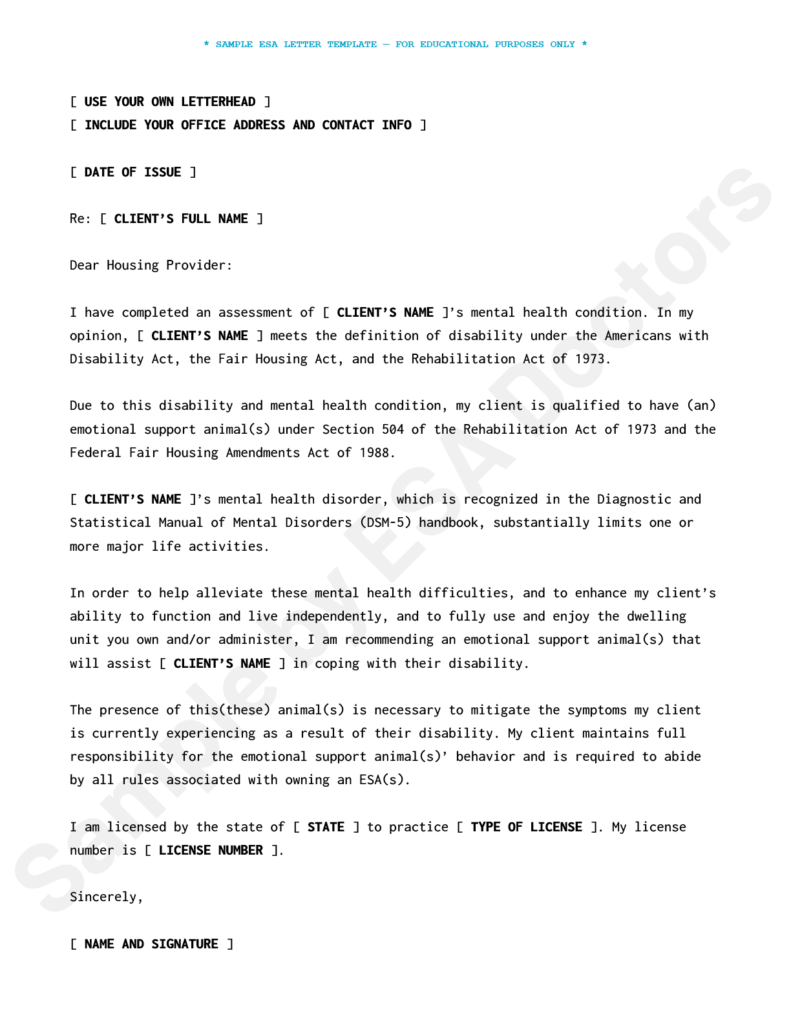
ESA documentation generally requires the following things: 1. The doctor or therapist’s license number and contact information, 2. Their signature, 3. A statement that your emotional support animal is necessary for your mental health condition.
Keep in mind that you have a right to privacy with ESA documentation. The doctor does not have to put in specific details about your diagnoses or medical history. Landlords are also not allowed to ask for this information directly.
What To Do if Your Doctor Can’t Help
If in the end, your doctor isn’t able to write an ESA documentation for you, don’t be discouraged. There are many reasons doctors and therapists can’t provide ESA documentation that are completely unrelated to your need for one. Many don’t feel comfortable provide an ESA documentation; some are prohibited from doing so because of their clinic’s policies, and some don’t have the administrative structure needed to respond to landlord verification requests.
If that’s the case, you can look for an online mental health professional who specializes in ESA documentation. Many doctors and therapists will refer their patients out to these providers. And yes, under Federal and state rules, ESA letter from online providers are just as good as ones from your physician’s office.
Frequently Asked Questions
Your doctor or therapist will charge you for their time in evaluating you for the ESA documentation and the time it takes to write it. That may be an office visit charge or an hourly rate. Your doctor or therapist might also charge a separate fee for ESA documentation; you will need to ask them directly to better understand their policy.
Insurance might cover the cost of your appointment with your doctor or therapist. You should check the terms of your policy to confirm that’s the case.
Health professionals are not responsible for the actions of your pet; you are. Their role in the ESA process is to evaluate whether you have a health condition that meets their criteria and whether a support animal would help. You can even get ESA documentation before adopting the pet that will be your emotional support animal. If they don’t want to provide ESA documentation for you, you can qualify for an ESA letter online by working remotely with a licensed healthcare professional.
Yes, state laws and previous HUD guidelines have made it crystal clear that ESA documentation from remote sessions are okay, as long as they’re from an actual licensed healthcare professional. Just make sure to use a service that connects you with a provider licensed in your state who takes the time to evaluate your need for an ESA.




My landlord has a form that has to be filled out by the physician. Does ESA doctors fill out forms generated by the landlord?
Landlord cannot insist on a specific form from healthcare providers. They must rely on the ESA letter written by the provider if it meets HUD’s requirements.
If I paid a none refundable pet deposit for my pet now he is Esa pet can I get my deposit back
Please see our article about how to get your pet deposit back.
Hello I wanted to ask a few questions.
1) can osteopathic physicians give out Esa papers?
2) what are the red flags to see for a company that is not a real ESA helpers ?
Physicians are one type of licensed healthcare professional permitted to write ESA letters. For red flags, please see this article: https://esadoctors.com/dont-be-scammed-fake-esa-letters/
Hi there, I am looking into renting a house within the next couple months. I’ve registered my Dog as an ESA but I am not sure what I need to do next. I know that the property management I will work with requires ESA documentation. Is the next step to receive a letter? I filled out the questionnaire form on your site and I want to know if an online doctor will be reviewing for me. I just want to make sure what my dog (Pitbull) will be able to move in with me free of charge seeing as she is my necessary support animal. Please let me know my next step as I only filled out the questions on the website and from viewing all of the comments it looks like a doctor to sign off/approve so that I can submit that to the property management. Let me know, thanks!
You cannot qualify for an ESA by “registering it”. The only way to qualify for an ESA is to have a signed letter from a licensed healthcare professional. HUD allows landlords to demand an ESA letter as proof that a tenant has a valid emotional support animal. Please see this link for more info: https://esadoctors.com/esa-letter/
Is there a max period of time I have to meet between my letter and adoption of my ESA? I want to register for 3 pets but we don’t plan on adopting our third pet for another 6 months. Also, is our landlord allowed to ask or keep information about our ESAs? For example, if they ask for a picture and I haven’t adopted the pet yet, what do I say?
There is no time limit but most ESA owners either already have their ESA or plan to get one soon when they get their ESA letter.
What do I do once I have a letter from my LMPH?
You can submit it to your landlord to let them know that you have an emotional support animal.
We don’t have an animal yet. Is it possible to get a letter first or does my animal information have to be on the letter
You are allowed to get an ESA letter before or after adopting your ESA.
I have an ESD now can I let family and friends walk my dog in a dog restricted community?
We’re not 100% clear on your situation, but generally speaking ESA rights are specific to the owner of the ESA that possess the ESA letter.
I have a dog in argentina, and a psycologist here. Can he make a letter for me, or it has to be a US psycologist? I am moving during the fall to start clasees.
It would be better to get a letter from a U.S. licensed healthcare professional (and it does not have to be a psychologist). Landlords generally will want a letter from a professional that is licensed for your state. Please see this link for how we can help you: https://esadoctors.com/esa-letter/
My landlord says that there is only one esa allowed per apartment but my wife has an ESA and I need one as well, is what she’s telling me true?
We think you’ll find this article useful: https://esadoctors.com/how-many-emotional-support-animals-can-you-have/
hello, if I would like to register with you but I am under 18 (17) and I need the ESA paper since ill be coming to the US in august to start my fall semester (note I live in Saudi Arabia )
Unfortunately the LMHPs we work with can only assist adults. We would be happy to help you once you turn 18 however.
I have anxiety and when i get a question wrong at school or say something wrong i pinch myself and say bad things to myself in my head. can i get a ESA or do i not qualify for one ?
It’s best for a licensed healthcare professional to make that determination. If you would like to be connected to one, you can get started here: https://esadoctors.com/esa-questionnaire/