
 Reviewed by professional dog trainer:
 When anxiety hits in a bad way, sometimes you can start to panic. Your heart races, your thoughts get jumbled, and you might feel like you’re floating outside your body. Grounding is among the tasks a service dog does to bring you back. They’re like an anchor that keeps you from floating away.
Grounding tasks are specific things you teach your dog to do. Your dog learns to notice when you’re panicking, and then they do something to help, like lie across your lap or nudge your hand. Or they might find the exit when you can’t think straight.
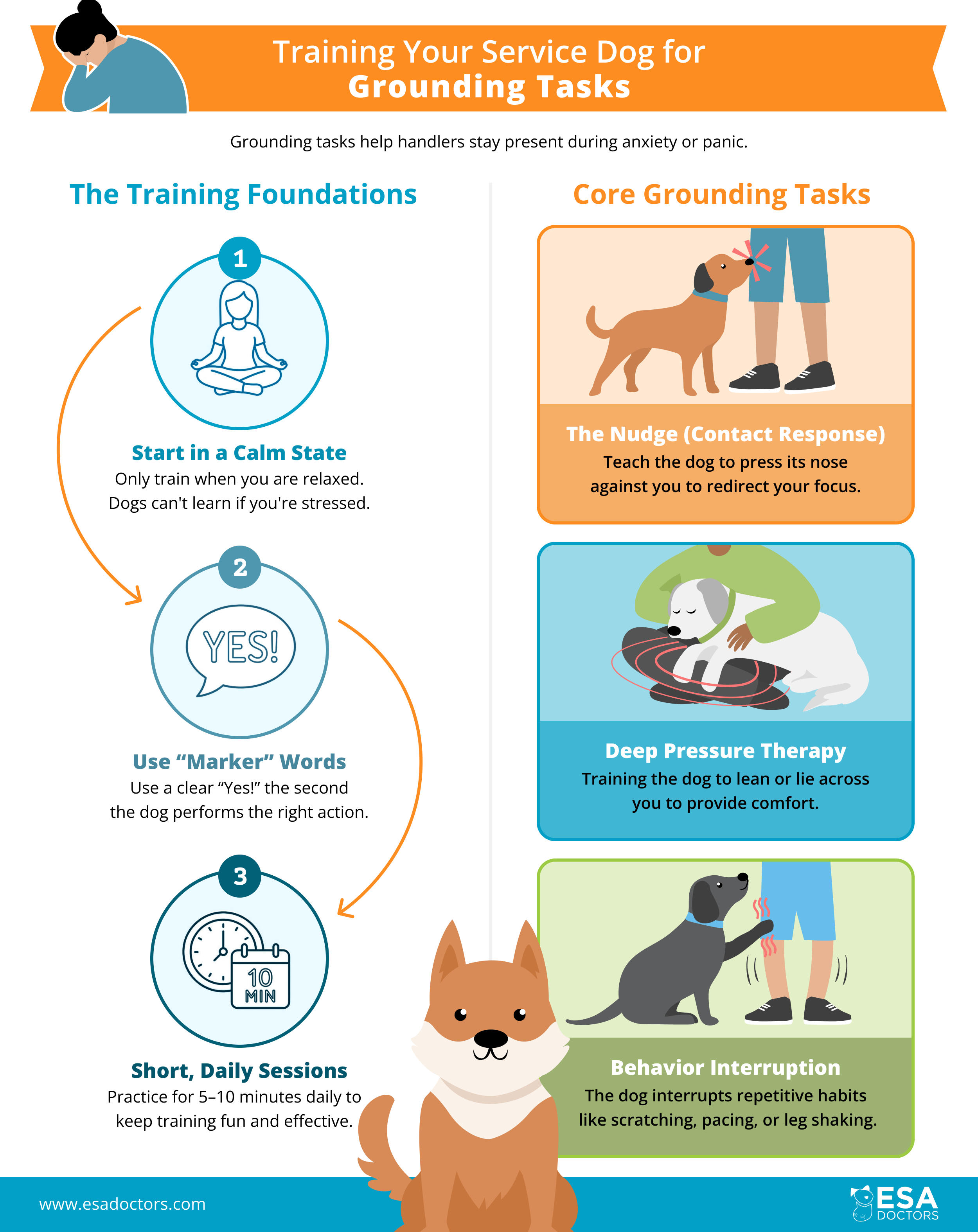
There are many types of grounding tasks, but these are some basic training principles for all grounding task training:
- Train when you’re calm.
Never try to teach during real anxiety. When we’re panicked, it’s difficult to think clearly, be consistent, and reinforce the behavior we’re trying to build. - Start stupidly simple.
Every task begins with something so easy it seems silly, like “touch my hand for cheese”. - Reward immediately.
Timing matters, so the second your dog does the right thing, say “yes!” and give a treat. Using a marker word like “Yes!” at the exact moment your dog does a behavior, helps them understand what is being rewarded. - Practice every single day.
Five minutes daily beats one hour weekly. Dogs learn through repetition. - One task at a time.
Don’t confuse your dog by teaching three things at once. Get good at one first. - Slowly make it harder.
Add one new challenge at a time, like longer duration, a new location, or more distractions. Increase one by one, not all three at the same time. - End on success.
If your dog is struggling, make it easier. Stop sessions before your dog gets tired or disengages. Ending while they are still successful helps them associate training with confidence and rewards, which builds enthusiasm for the next session. - Use the same words.
Pick one command and stick with it. Everyone in your house must use the same word. Consider keeping a written list of cues so everyone is on the same page and your dog receives clear, consistent communication. - Practice everywhere.
A task that only works at home won’t help at the store. Start in calm places and gradually visit busier locations. Dogs don’t automatically understand that a behavior learned in one place applies everywhere, so practicing in different locations helps them learn to do the task in real-life situations. - Work toward training around distractions, be more interesting than distractions.
Use amazing treats, be excited, and make training the best part of your dog’s day. Then slowly add distractions so your dog builds a history of success with you, learning that focusing on you is what consistently leads to the best rewards.
Types of Grounding Tasks Dogs Can Learn
These are a few of the “grounding tasks” that a service dog can be trained for.
Physical Tasks
- Deep Pressure is when a dog lies on you like a weighted blanket
- Nudging is when a dog bumps you with their nose over and over
- Paw Touch is when a dog puts paws on you to calm you down
- Face Touch is when a dog gently touches your face with their nose
Finding Things
- Find Exit is when a dog finds the door when you need to leave
- Find Car is when a dog leads you to your car
- Find Person is when a dog takes you to someone safe
- Make Space is when a dog stands between you and the crowds
- Find Quiet is when a dog leads you somewhere calm
Stopping Bad Habits
- Stop Picking is when a dog stops you from picking at your skin
- Wake You Up is when a dog wakes you from nightmares
- Stop Crying is when a dog nudges you while you are crying
- Break Freeze is when a dog gets more pushy if you freeze up
Bringing You Things
- Anxiety Alert is when a dog notices anxiety before you do
- Medicine Reminder is when a dog brings your medicine bag
- Comfort Items is when a dog fetches your blanket or fidget toys
Training for Contact Response (Nudging)
This teaches your dog to nudge you when you’re anxious. The nudging gives your brain something to focus on and pulls you out of the anxiety spiral.
Step 1:
Basic Touch
Hold your hand out near your dog’s nose. Most dogs will sniff it. When their nose touches your hand, say “yes!” Give them a treat right away.
Practice this many times in small sessions (under 1 minute at first). Do it for three days. Then add a command word, such as “touch” or “nudge.” Say the word, then hold out your hand. Soon, your dog will touch your hand when you say the word.
Step 2:
Longer Touch
Now make the touch last longer. When your dog touches your hand, count to three. Then say “yes!” and treat. If this is successful, make it longer each day and work up to 10 seconds in baby steps. If they don’t hold their nose for three seconds, temporarily back up to two seconds.
Try other body parts too. Have them touch your knee, then your shoulder, and then your leg. They should learn to touch wherever you point.
Step 3:
Reading Your Anxiety
This is the most important part. Your dog needs to notice when you’re anxious.
Practice when you’re calm. Act a little anxious by breathing faster, tensing up your shoulders, and making fists with your hands. At first, still say “touch.”
Later, wait and see if your dog notices and touches you without the command. The goal is for your dog to see that you’re anxious and help on their own.
Training for Behavior Interruption
You can teach your dog to stop you from harmful habits. Many people with anxiety pick at their skin or pull their hair without realizing it. Your dog can learn to recognize anxiety and interrupt these behaviors by nudging your hand away or getting between you and what you’re doing.
Teaching the Basic Interrupt
Start with something harmless. Pretend to scratch your arm. Not hard, just a gentle scratching motion. When your dog notices and comes over, say “yes!” and give them a treat.
Next, add a fake picking motion. Pretend to pick at your hand. Make it obvious at first, and when your dog shows any interest, reward them. Some dogs will nose your hand, some will paw at you. Any interruption is good.
Add the command “stop” or “break.” Say it while you’re doing the fake behavior. Reward your dog for any response. They might not know what to do at first, but that’s okay.
Making It Stronger
Now we will start to build on the starter behavior. When you pretend to pick, wait for your dog actually to touch you. Don’t reward just looking anymore; they need to make contact.
Teach them to be pushy about it. If you keep picking after they nudge once, they should nudge again. Keep rewarding the pushier responses. You want a dog who won’t give up.
Practice with different behaviors. Pretend to pick your face, scratch your neck, pull at your clothes. Your dog should interrupt all of these.
Real-Life Response
Start using this during real moments. If you catch yourself picking, say “stop” to your dog. Reward them for interrupting. Soon, they’ll notice on their own.
The goal is for your dog to see the behavior and stop it without a command. They notice you picking and immediately nose your hand away. They see you pulling your hair and paw at your arm.
Some dogs get creative. One dog learned to bring a toy when their owner started picking. Another would lie their head on their owner’s hands. Whatever works is fine because the point is to interrupt the harmful behavior.
Training for Finding Exits
When you panic in public, you might forget where the door is. Your dog can learn to find it for you and become your guide when you can’t think.
Step 1:
Learning About Doors
For one week, make doors special. Every time you go through a door, stop. Have your dog sit. Say “exit” in a happy voice and then go through. Do this with every single door.
After a week, stand in a room. Wait for your dog to look at any door, even if it’s by accident. Say “yes!” and give a treat. Soon, your dog will look for doors on purpose.
Step 2:
Going to Doors
Stand in the middle of a room. Say “find exit.” If your dog walks toward any door, say “yes!” Throw the treat by the door. If your dog isn’t yet moving toward a door, go back and reinforce earlier steps a bit longer. Reward any look or movement toward doors before expecting full approaches, then build forward again once that’s consistent.
Practice in every room of your house. Your dog should walk to a door when you say “find exit.”
Step 3:
Public Practice
Start somewhere easy, like a pet store. Stand near the exit. Say “find exit.” Reward your dog for looking at or walking to the door.
If your dog isn’t yet finding the exit in a new space, it usually just means the environment is a bit too challenging right now. Return to a quieter, easier location, reinforce success there, and then gradually increase difficulty again.
When they succeed in one location, graduate to bigger stores next. Any exit is good; if there are three doors and your dog picks any of them, that’s success.
When to Get Help
It might be a good idea to find a professional trainer for help if you run into any of these issues while training your dog for grounding tasks:
- Your dog is scared of people
- Your dog growls or snaps
- Nothing improves after a month
- Training makes your dog nervous
- You don’t know what to do next


Leave a Comment