
 Written by:
 Cats have a very complex communication system! They communicate through body language, vocalisation, facial expressions, and scent marking. A cat’s character and behaviors are influenced by their early life experiences during kittenhood, as well as genetics. As a solitary and territorial species, their home environment also plays a huge role in how happy and safe they feel. Meaning your home life can have a marked impact on their behaviour.
Understanding Cat Communication
Cats have a much more complex communication system than humans! They communicate using several senses: sight (visual cues through body language, body position, and facial expression); touch; hearing (vocalisation), and smell (pheromones).
Visual Cues
Cats use visual cues to tell us how they are feeling, including:
Tail Position
A happy, relaxed cat will have their tail upright, possibly with the tip slightly curled, or held loosely away from their body. On the other hand, an anxious cat will have their tail tucked between their back legs or tucked tightly into their body. An angry cat will have a tense tail, which they may move slowly from side to side. They may also hold their tail upright, with the hair puffed out (and possibly a ridge of fur raised over their spine).
Facial Expression
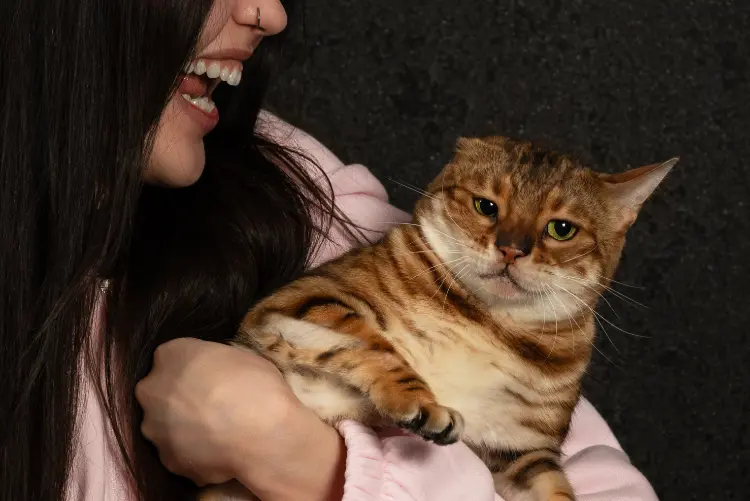
A happy, relaxed cat will have their ears in their natural position, with a closed mouth and relaxed eyes (in their usual position and shape). Their whiskers will be in their natural position. However, an anxious cat will hold their head slightly lowered, with their ears horizontally, pointing sideways, or flat against their head. They may also have dilated pupils. They may bunch their whiskers together and flatten them against their face. A cat who is feeling angry will either have erect ears, rotated outwards so they point to the sides, or lowered ears, flattened towards the head. Their pupils may be narrowed or dilated, and their mouths may be open, showing their teeth.
Eye Contact
A relaxed cat will have relaxed eyes, blinking as usual or possibly holding them half closed. An anxious cat who feels threatened may look away or blink excessively. A cat holding their eyes wide open, rarely blinking, may be getting ready for conflict or responding to a possible threat.
Whole Body Posture
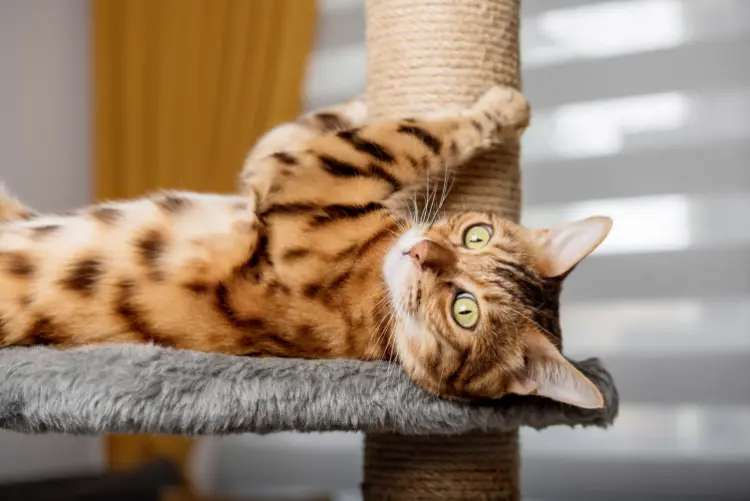
A relaxed cat will have a relaxed body posture! They may lie, sit, or curl up with some paws off the ground. They may tuck their paws under their chest. They lay down, stretched out, possibly with some belly showing. They may even roll from side to side on their back, in a friendly or playful greeting.
An anxious cat may appear crouched to the ground, with all paws on the ground, in case they need to flee. They may hide. An angry cat could stand with an arched back and erect fur. They may also stand with one paw off the ground (ready to swipe!). They may lie with their bodies tensely flattened against the ground.
Many of these visual cues are subtle and hard to read! You can see diagrams of these visual cues in this research paper. Try watching your cat closely in different scenarios, so you can start to learn their individual behaviors and body language. Recognising these signals will help you respond to their needs and mood, improving their well-being.
Vocalisation
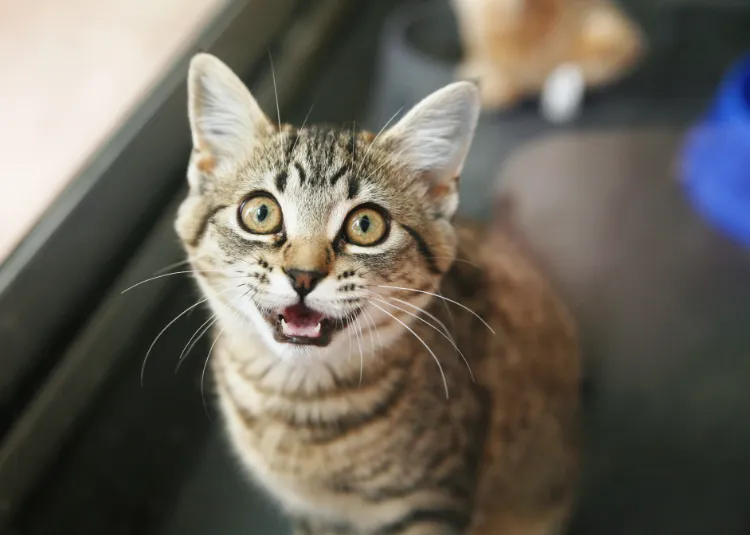
Cats use vocal communication in many scenarios: as a greeting, to interact with offspring, during courting, to indicate hostility, or as a warning. For example, purring often indicates contentment or a friendly greeting. However, cats may purr when they are anxious, almost like a self-soothing mechanism. Meowing is often directed at owners, and often indicates a desire (or demand in some cases!) to be fed or petted. On the other hand, yowling and hissing indicate hostility and are often a cat’s way of saying ‘back off’.
Touch
Cats rub their faces or bodies against each other (or us!) as a means of communication. They may also groom each other or sleep curled up together. This also transfers their scent to the receiving cat/human, which leads to communication using smell.
Smell & Scent
Cats have an excellent sense of smell, much better than we do! They use scent as a very important means of communicating with each other. For example, they use urine spraying to mark their territory. They may also leave their stools unburied along the edge of their territory, as another means of marking their territory.
Cats use their sebaceous and sweat glands to communicate, too. For example, they swap scents when they rub their skin against you or another cat. When they scratch things, they are transferring scent from glands on their paws onto the object (as well as leaving a visible mark of their presence).
Cats are highly intelligent creatures, and cat communication is complex! The more we can understand what our cats are trying to tell us, the happier they will be.
Understanding Cat Behavior
Just like us, each cat will have its own personality and therefore unique behaviours. That’s what makes them so lovable! Understanding our cats’ behaviour is key to creating and maintaining our special bond with them and to providing them with the best care we can. In order to understand what behaviours are abnormal and may indicate an issue, we need to know what normal cat behaviors look like.
What’s ‘normal’ for your cat will be unique to them, depending on their genetics and early life experiences. However, there are some species-specific, common behaviours. Some examples of common, ‘normal’ cat behaviors include:
Playing
Chasing, stalking, and pouncing are normal aspects of feline play. This sort of play allows them to express their natural hunting behavior, which provides both physical and mental stimulation.
Jumping Up to High Places
Cats naturally prefer to be up high. Being high means a better view of their prey, and they feel safer (since, in the wild, they are also prey themselves).
Kneading
Whether it’s a pillow or your lap, many cats like to knead something soft! They are mimicking the behavior they made as kittens, to self-soothe and form a bond.
Headbutting
If your cat rubs their face on you or the furniture, they are marking their territory using scent glands in their cheeks. Headbutting can also be a playful form of attention seeking!
Vocalising
All cats communicate through sound, but some cats are more vocal than others!
It’s important to note that even these ‘normal’ behaviours can be considered ‘unwanted’ if they are inappropriately directed or timed. An example could be if your cat is pouncing at your legs. They may be playing, but it is inappropriate play and may hurt you or a child.
Remember, what is ‘normal’ or ‘abnormal’ for your cat may be different from someone else’s, so try to pay attention to how they behave. If you can learn what is ‘normal’ for your cat, you’ll be able to recognise any behavior that is out of the ordinary, and so could signal a problem.
Common Cat Behavioral Problems
Most pet parents use the term ‘behavioral problem’ to describe unwanted, problematic, or ‘naughty’ behavior. The behaviors may well be ‘normal’ for the cat, but unwanted by the owner. For example, cats will spray to communicate when stressed, but spraying in the house is unacceptable to most owners! Some common cat behavioral problems include:
Aggression
Aggression can be towards other cats or towards people. There are several possible motivations for cat aggression, including:
Fear-Based Aggression
A cat’s natural (and very sensible!) instinct is to run away from a threat. However, if they can’t see a way out, or have learned that running away doesn’t work, they may defend themselves aggressively.
Territorial Aggression
Cats are territorial by nature, so they may aggressively defend their territory. This is more common when a new cat joins the neighbourhood, or in multicat households.
Play Aggression
Unfortunately, this is often a learned behavior. Kittens are cute! When they are tiny and attacking our hands, we may think it’s adorable. However, if we encourage them and don’t back away when they are too rough, they will not learn to play appropriately. When they are adults, this behavior can then be seen as aggressive, since they are now hurting us!
Petting Aggression
Cats tend to enjoy interacting little and often, whereas humans are often the converse! So we often wish to interact with our cat less frequently but for longer periods. This can be overwhelming for some cats, who have a limit as to how much petting they enjoy. Overstimulation can manifest as aggression.
Pain-Related Aggression
Just like humans, a cat in pain will be less tolerant than a healthy cat. Pain can lower their threshold for aggressive behaviors. A bit like us losing our temper more quickly when we are feeling rotten!
Scratching the Furniture
Cats scratch objects for many reasons:
- to sharpen their claws,
- to mark their territory (by leaving both a visual mark and a scent mark, from the scent and sweat glands in their pads), and
- to stretch their muscles.
Most owners don’t mind if their cats are scratching a tree or a scratching post. However, when they are scratching the expensive furniture, this is understandably seen as a problem.
Inappropriate Toileting
Cats are very clean creatures and will usually toilet outdoors or in a litter tray. If your cat starts toileting around the house, this could indicate an underlying issue. Cats may spray in the house to mark their territory if they are stressed or feel threatened, for example, by a new cat.
Causes of inappropriate soiling include dirty litter trays, too few litter trays, the type or position of the litter tray, previous bad experiences in a litter tray, litter tray liners, and scented cat litter (which often puts cats off). Illness and old age issues, such as arthritis or senility, are other common causes to consider.
Meowing and Yowling
Some cats are naturally more vocal than others. However, if your cat suddenly starts yowling constantly or through the night, this may be seen as a problem behaviour. Possible causes of the behavior change include high blood pressure, senility, seasonal changes, or pain.
If you are struggling with any of these behaviors, you are not alone! These are common issues, and there is help at hand.
Causes of Problem Behavior in Cats
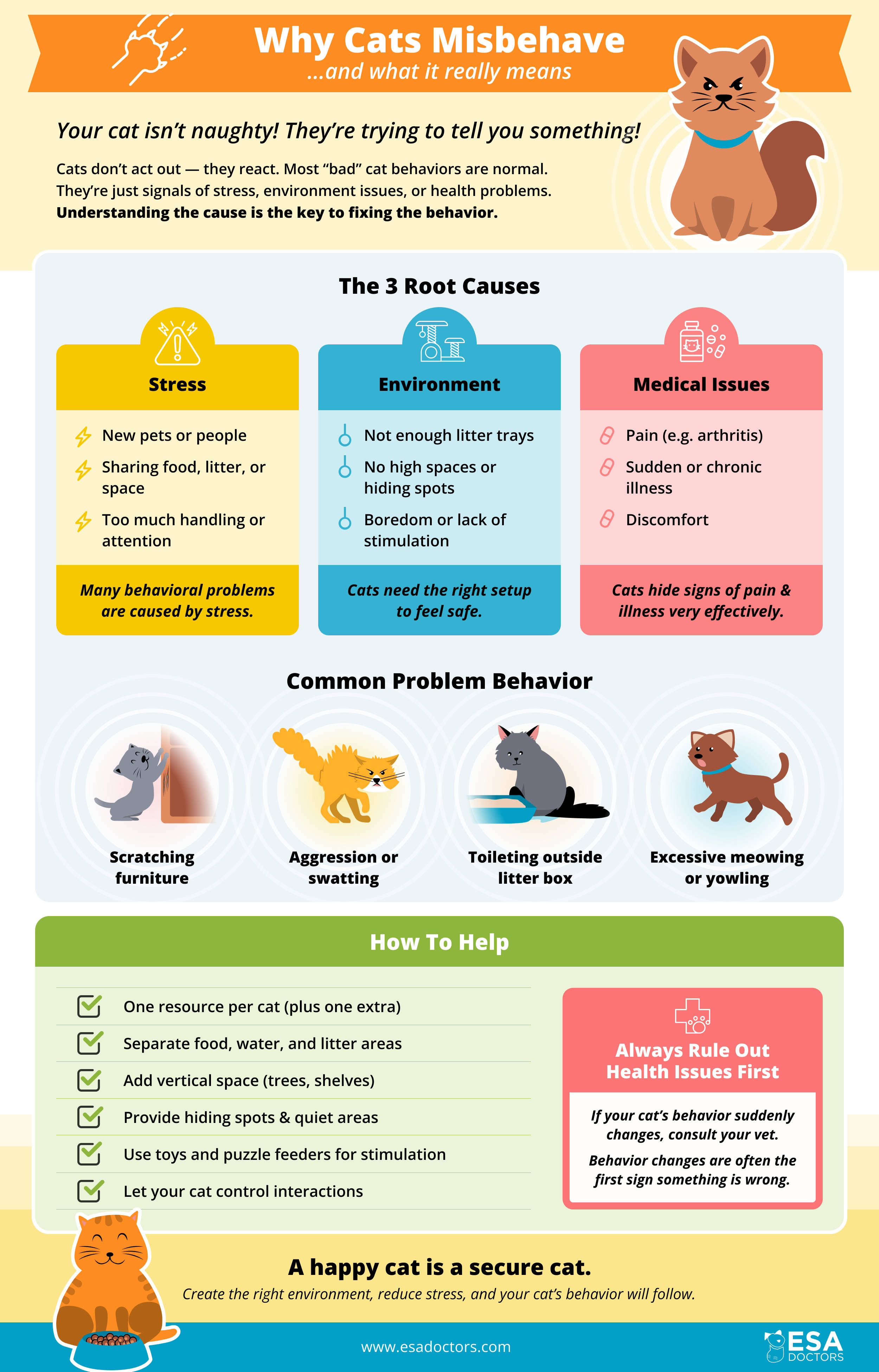
Many of these behavioral problems are actually ‘normal’ cat behaviors that are excessive, inappropriately timed, or inappropriately directed. So, what causes problem behaviors in cats?
Stress
Many behavioral problems in cats are caused by stress. Stress can even cause illness in cats, such as with FIC (feline interstitial cystitis). Cats can be stressed by:
Interactions With Other Cats
If cats share resources with other cats in the household, such as litter trays, bowls, beds, scratching posts, etc., it can cause considerable stress, especially for indoor cats.
Outdoor cats may be stressed by other cats encroaching on their territory, especially in areas with large cat populations. Cats are territorial, rather than naturally sociable like us!
Interactions With People
Some cats love being petted, whereas others have a limit! Some cats don’t enjoy being picked up too much, for example. Therefore, pet parents may unwittingly contribute to their cat’s stress by wanting more interactions than their cat can handle. Some cats may also be stressed by interactions with unfamiliar people, such as visitors to the home.
Cats also don’t respond to being punished. Punishing a cat for inappropriate behavior is likely to make them more stressed and worsen the behavior.
Factors in Their Environment
An inappropriate home environment, for example, one lacking suitable hiding places or escape routes, can cause or contribute to stress in cats. And a lack of physical and mental stimulation can also cause stress in cats.
Medical Causes
While stress is a very common cause of behavioral problems in cats, it’s very important to rule out medical causes first. You may not be on your best behavior when you’re feeling rotten, and the same goes for your feline friend! Because cats are predators and prey, they hide signs of pain and illness very effectively. This protects them from appearing weak and being preyed upon. So sometimes all we notice are subtle changes in behavior.
A common medical cause of behavioral problems in cats is chronic pain, such as arthritis. Arthritis is very common in middle-aged to older cats. If your cat is arthritic, they may be reluctant to interact, for fear of pain. This may cause them to lash out (hiss, scratch, bite) or hide away when humans or other cats approach them. Arthritis may also cause them to toilet inappropriately around the house, as they may find it hard to get into the litter tray or to go outside. Feline interstitial cystitis (FIC) can also cause cats to toilet around the house. This could be misinterpreted as problem behavior, when they are actually uncomfortable and feel an urgent need to go.
When to Contact Your Veterinarian
Sometimes, ‘problem’ behavior may be subtle. You may notice your cat sleeping in unusual places, or you may describe them as ‘not quite themselves’. They may be hiding more than usual or excessively grooming themselves. These behavioral changes often indicate an underlying medical issue, and a trip to their veterinarian is in order.
While many problem behaviors can be caused by stress, it’s essential to rule out underlying medical causes before deciding the behavior is stress-related. Firstly, leaving a medical condition untreated could make your cat seriously unwell. Secondly, the behavior will not improve without addressing the underlying cause. So, if your cat has any behavior problems or you notice any changes to their behavior or routine, you must book an appointment with their veterinarian. They will also be able to recommend clinically trained, accredited behaviorists if needed.
Supporting Healthy Cat Behavior
Learning about your cat’s behavior and why they behave as they do will enable you to encourage the behavior you’d like to see.
Before you ask How can I stop my cat from doing this thing I don’t like’, consider whether you actually should be stopping it. Most unwanted or ‘problem’ behaviors in cats are natural behaviors that a cat needs to express to be content. If we try to stop them, we often make things worse. Instead, we want to redirect the behavior to a time or place that is acceptable to us as owners.
Making your home cat-friendly is an important part of preventing or treating unwanted behaviors and, therefore, supporting healthy behavior. The less stressful the environment is for them, the more positive their behavior is likely to be. You should never punish your cat for ‘bad’ behavior, since this will almost certainly make them stressed, and their behavior will get worse.
How to Make Your Home Cat-Friendly
Your cat needs to be able to perform their natural, innate behaviors, without competing for resources. Here are some top tips for creating a cat-friendly space:
Creating a Comfortable & Low-Stress Environment
- Have one of each resource (such as a bed, scratching post, litter tray, food, and water bowls) for each cat, plus one spare. This will reduce competition between cats. Even if all your cats use the same litter tray, giving them a choice will reduce stress.
- Space these resources apart to allow cats their own space.
- Offer plenty of choice of warm, ideally raised, cat beds.
- Provide plenty of high resting places. Cats prefer to be up high, where they feel safest. This could be cat trees, shelves with non-slip surfaces, or radiator beds.
- Provide hiding places around the home. These can be small, warm ‘dens’ anywhere your cat feels safe. Be sure to explain to any children that the cat should never be disturbed when in their ‘safe space’.
Litter Tray Setup & Preferences
- Ensure litter trays are in private locations where your cat won’t be disturbed.
- Make sure your cat can access their litter tray easily, for example, arthritic cats or little kittens will need low-sided trays.
- Cats don’t tend to like litter tray liners or scented litter, and it’s best to avoid strong-smelling cleaning products.
- Some cats find hooded litter trays stressful. There is no exit should another cat approach, leaving them feeling trapped.
Feeding & Water Habits
- Cats naturally eat little and often, and in nature would have to hunt for their meals. Using puzzle feeders can help mimic this natural pattern, mentally stimulating your cat while allowing food to be given little and often. You can find more tips on feeding your cat here.
- Cats often prefer wide-based bowls, so their whiskers don’t touch the sides. Many cats are put off by plastic bowls, which can taint the taste of food or water.
- Place the food and water bowls away from each other. Cats don’t like to drink near where they eat, as the water may be contaminated with food.
- Place each cat’s bowl separately, away from each other, so they can eat without seeing other cats. Cats are solitary hunters; they would view other cats nearby as potential competition for food.
Scratching & Territory
- Encourage your cat to use their scratching post by making sure it’s sturdy, tall enough for them to stretch out fully, and preferably near their bed. Cats tend to love a good scratch after a nap! You could also use a cat pheromone spray on the post to encourage your cat to use it.
- If you have a cat flap, it’s a good idea to invest in a microchip-activated one. This prevents other cats from entering your house and into your cat’s territory.
Play, Enrichment & Stimulation
- Play with your cat and allow access to toys! Toys that mimic hunting are usually well-received. Try alternating through different toys to keep things interesting.
- Indoor cats benefit from fresh air too! Whether it’s a catio or an open window (with a protective grid to prevent them from escaping), fresh air will bring new and interesting smells.
Social Interaction & Emotional Support
- Let your cat initiate social interactions, and learn to read their body language, so you know when they have had enough, and you need to stop.
- Synthetic cat pheromone plug-ins can help your cat feel calm at home.
Take-Home Message
If your cat is exhibiting unwanted behaviors, you are not a bad pet parent. The fact that you are here researching proves quite the opposite! It’s essential that you take your cat for a check-up with their veterinarian if they show any unusual or unwanted changes in their behavior. There may be an underlying medical cause. Your veterinarian will also be able to refer you to a clinical behaviourist if needed. Making your home as cat-friendly as possible will encourage and support healthy cat behavior. By meeting all of your cat’s innate needs, they are much less likely to show unwanted behaviors.
Does your cat provide emotional support?
Work with a licensed professional to get a legit ESA letter in your state.

Leave a Comment