
 Written by:
 You may have wondered if your feline friend can sense when you’re sad. Naturally, cats can’t understand emotions in the same way that we do. However, they can differentiate between negative and positive emotional states and seem to respond appropriately to our moods. It’s definitely possible for cats and humans to form strong emotional bonds!
Do cats know when you are sad?
You’ve probably shared many moments where you and your cat seem to sense each other’s mood. Maybe you’ve noticed your cat behaving differently when you’re sad. Is this a coincidence, or can your cat actually tell when you’re sad?
While cats can’t understand sadness as humans do, they are capable of detecting changes in your mood. They may even respond in ways that seem like concern or an attempt to comfort. So let’s take a look at what the science tells us!
The Evidence
We know from studies that cats can recognize and respond to communication signals from both other cats and from humans. Understandably, there are limited studies on a cat’s actual perception (or understanding) of emotions or communication signals.
One 2020 study investigated a cat’s ability to recognize human emotions, as well as the emotions of other cats. The results of the study suggest that cats can recognize emotions and appear to change their behavior based on the emotions they perceive. While this was a very small-scale study and further research is needed, it does suggest that our cats may truly sense when we are sad.
How Cats Sense Sadness in Humans
The same 2020 study suggests that cats use both visual (seeing) and auditory (sound) signals to recognize emotions.
So, while cats can’t understand sadness or grief as we can, they can tell the difference between humans feeling sad, happy, or angry. They use our facial expressions and posture, along with our tone of voice and other sounds we make (such as crying). Much in the same way that they can read another cat’s mood by looking at the position of their tail, eyes, and other body language cues, alongside sounds such as hissing.
Another study presented cats with human odors collected in different emotional states: fear, happiness, physical stress, and a neutral state. The study found that odors collected from humans experiencing fear caused higher stress levels in cats (compared with physical stress and neutral odors). In other words, they could smell human fear and respond appropriately by feeling stress themselves.
Together, these studies suggest that cats use their senses of sight, hearing, and smell to detect human emotions.
How do cats react to human emotions?
The 2020 study also demonstrated that cats respond to human anger. The behaviors the cats showed when exposed to an ‘angry’ human were indicative of higher stress levels compared to their behavior when reacting to ‘happy’ humans.
Cats in the study not only showed more positive behavior when their owner appeared happy, but also spent more time in contact with their owner. When humans used angry expressions and voices, cats tended to spend less time with them and, in some circumstances, looked for an exit.
One 2024 study examined how cats responded to humans with angry expressions and body language, compared with humans showing positive expressions. The results showed that cats were more likely to show positive emotions themselves and to approach humans when the human was showing positive emotions, rather than when the human was showing anger. The study concluded that it is likely that cats can both recognize human emotions and respond to them.
Signs Your Cat Knows You Are Sad
There are no clear-cut signs that your cat knows you are sad. However, the strong emotional bond you and your cat share likely means you can read each other’s body language.
Signs that could indicate your cat senses your sadness include:
- Rubbing themselves on you, or head-butting you
- Purring
- Approaching you
- Sitting on your lap
- Following you around
- Staying close by, or sitting near you
Some cats may avoid you if they sense you are angry (or even sad), as your negative emotion can trigger a stress response in them.
Do cats feel your sadness or mirror your mood?
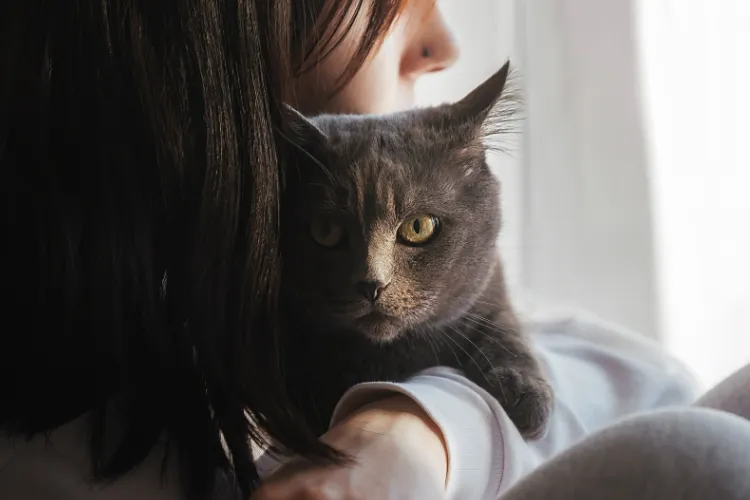
Studies have shown that cats can sense different human emotions and respond accordingly. However, this may be because negative human emotions cause a stress response in your cat, rather than them actually understanding your sadness. So cats can likely sense that you are sad and may also mirror your mood. Of course, your cat may genuinely be trying to cheer you up; only your cat knows the answer!
Naturally, all cats have unique personalities. Your cat may react in an unexpected way when you are feeling sad: not all cats are ‘cuddly’! So, if your cat seems to back away from you when you’re angry, sad, or stressed, don’t take it personally!
What to Do if Your Cat Seems Extra Attached or Distant When You’re Sad
As comforting as it is when your cat seemingly tries to cheer you up, naturally, you don’t want your cat feeling sad, too! If your cat shows you some extra attention, cuddles up to you, or gives you a bit of a wide berth, these are all normal reactions.
However, if your cat seems extremely attached or distant, it’s safest to check they’re ok too. Being extra clingy or hiding away can both be early signs of pain or illness in cats. If you’re worried or the behavior continues, it’s safest to have them checked over by your veterinarian.
If there’s no medical cause for your cat’s behavior, they may well be reacting to your mood. If your cat is showing more affection than usual, it’s OK to enjoy it! You can both take comfort from your special bond. However, if your cat is more distant than normal when you’re sad, it’s important not to force interactions, since this will stress your cat. Let them come to you when they are ready. It’s also important not to take it personally! This reaction doesn’t mean you aren’t bonded or that they don’t love you.
What This Means for You & Your Cat
Cats are incredibly intelligent creatures. They can sense audible, visual, and olfactory (scent) cues about our mood and respond accordingly.
Cats can provide us with emotional support, with studies showing clear health benefits of cat ownership. Sharing your home with a cat can reduce your stress levels, calm and comfort you. Studies have suggested that spending time with your feline friend may even stimulate the release of the hormone oxytocin (one of the ‘happy hormones’!). Your cat’s ability to detect and respond to your emotions plays a key role in your special relationship.
Does your cat provide emotional support?
Work with a licensed professional to get a legit ESA letter in your state.

Leave a Comment