

 Medically reviewed by:
 This article was last updated on December 19, 2025.
To learn about the rules for emotional support animals, refer to the latest guidelines from HUD, the U.S. Department of Housing and Urban Development. HUD is the authority for understanding what’s what when it comes to ESAs. These rules spell out how landlords and tenants should handle ESA requests under the Fair Housing Act.
This article addresses 14 important details about HUD’s rules and is intended to help tenants understand their current rights as ESA owners.
Whether you’re someone who needs an emotional support animal in your home or a property owner trying to comply, this guide will help you understand HUD’s rules.
You need an ESA letter if you want an emotional support animal
Here is maybe the most important thing to know about HUD’s ESA rules: if you want your pet to be recognized as an emotional support animal, the only way to do it is by getting an ESA letter. If you’re a landlord and you want to verify that your tenant has an ESA, the only document you can ask for as proof is an ESA letter. For an ESA letter to comply with HUD’s rules, it has to have the following:
- Written by a licensed healthcare professional (like a physician, psychiatrist, psychologist, nurse, counselor, or social worker)
- Be signed and dated by the provider
- Contain the provider’s license number and contact information
- State that the healthcare professional has a professional relationship with that patient/client
- Specify the type of animal(s) the ESA is
- State that the tenant has a mental impairment that substantially limits one or more major life activities
- State that the patient needs the animal(s) because they provide therapeutic emotional support
As a landlord, if you get an ESA letter that meets HUD’s requirements, you can’t ask for additional forms from the healthcare provider (more on that later).
Landlords can’t charge fees and deposits for ESAs
Under HUD’s rules, landlords can’t charge fees and deposits in connection with ESAs, including application fees. Even if the building charges a monthly fee or deposit for regular pets, ESA owners are exempt from these fees.
A landlord can, however, charge you for any damage your emotional support animal causes. Landlords sometimes complain about not being able to charge fees and deposits to cover potential damages from an ESA. Still, HUD’s rules confirm that ESA owners are responsible for the actions of their animals. Landlords can also deduct costs associated with damage caused by an ESA from the standard security deposit charged to all tenants.
Landlords can’t enforce breed and weight restrictions
When it comes to emotional support animals, the usual pet rules go right out the window. This is a significant point: landlords can’t tell you that your ESA is “too big” or that they “don’t allow that breed.” Even if a building has a strict “no pit bulls” or “no dogs over 30 pounds” policy for regular pets, these restrictions don’t apply to properly documented emotional support animals.
Why? Because ESAs aren’t classified as pets under the Fair Housing Act, they’re considered assistance animals that provide necessary support for a person with a mental health disability.
That said, landlords can still deny an ESA if the specific animal has a history of misbehavior that poses a direct threat to the safety or health of others. For example, if your emotional support dog has previously bitten someone or regularly destroys property, a landlord might have grounds to say no. However, this rejection should be based on the individual animal’s actual conduct, not assumptions made based on size or breed.
Landlords have to respond to ESA requests within 10 days
If you’ve given your landlord an ESA letter, they have to get back to you promptly. To be specific, HUD’s rules state that the housing providers should respond “promptly, generally within 10 days of receiving documentation.” Your landlord can’t drag their feet or prolong the process to deter you from having an ESA; you’re entitled to a fast response.
Landlords can’t require the healthcare professional to use a specific form
One common obstacle that tenants face is that landlords sometimes insist that additional forms be completed by the healthcare professional in addition to the ESA letter. Landlords can also make other unreasonable demands, like asking the healthcare professional to make sworn statements.
HUD has explicitly stated that landlords can’t require a healthcare professional to use a specific form, provide notarized documents, make statements under penalty of perjury, or provide an individual’s diagnosis or other detailed information about a person’s mental impairments.
You can still choose to have your healthcare professional complete landlord forms that are just confirmatory and don’t ask for sensitive details about your condition, but that’s completely up to you and your provider.
Landlords can’t request details about the tenant’s condition
Sometimes, landlords will demand to know more details about your condition and why you need a particular ESA. HUD has emphasized that housing providers can’t request specific details about your health. They also can’t request access to medical records or insist on a medical examination. HUD’s rules are clear that landlords aren’t entitled to know your diagnosis or details about the severity of your disability. That information stays between you and your healthcare provider.
When it comes to your mental health history, you have a right to privacy and confidentiality.
ESA requests can be made orally or in writing
You can request accommodation for your ESA orally or in writing. The request can also be made directly by the ESA owner or by someone else on their behalf, such as a person legally residing in the unit with the ESA owner, a legal guardian, or an authorized representative. You don’t need to submit a written request or use the words “reasonable accommodation,” “assistance animal,” or any other special words to request accommodation for their ESA.
Many people find that making a written request is helpful for their personal records. But, it’s sufficient to simply inform the landlord that you are requesting to live with your ESA and share your ESA letter. If you’re nervous about telling your landlord, check out our guide on informing your landlord about your ESA.
HUD does, however, encourage tenants to specify that they are requesting “reasonable accommodation” for an emotional support animal to make things crystal clear. HUD also recommends keeping a copy of your accommodation request and any supporting documentation, which will come in handy in case there’s a dispute about whether an ESA accommodation request was ever made.
Tenants can make an ESA request before or after adopting the ESA
Under HUD’s rules, you can request ESA accommodation both before and after acquiring your emotional support animal.
HUD states that you can make an ESA request at any time, and the landlord has to consider the request even if you made it after bringing your ESA home.
You should always be transparent with your landlord about your ESA situation and inform them as soon as possible if you plan to have one. Sometimes landlords find out that a tenant has been keeping an ESA in secret and threaten to kick out the ESA or terminate the tenant’s lease.
HUD has stated that in these situations, the tenant can still submit an ESA request, but the timing may create the impression that the tenant acted in bad faith (i.e., the tenant obtained an ESA solely to skirt pet rules). That means a couple of things:
First, if you think you might qualify for an ESA, you should seek help from a licensed professional as soon as possible, and not only after you bring an animal home and your landlord discovers it.
Second, you should always try to inform the landlord prior to the ESA moving in. That’s not always feasible — for example, if you already live with a pet and then that pet later qualifies as an ESA.
The bottom line is that you should never try to hide an ESA from a landlord and aim to send your request for ESA accommodation as soon as you have your ESA letter. You can also submit the request to your landlord prior to actually adopting the animal that will become your ESA.
Dogs, cats, small birds, rabbits, hamsters, gerbils, other rodents, fish, and turtles can be ESAs.
Emotional support animals are typically dogs and cats, but many types of animals can serve as wonderful companions that provide emotional support. According to HUD, any “small, domesticated animal that is traditionally kept in the home for pleasure rather than for commercial purposes” can be an ESA. Dogs, cats, small birds, rabbits, hamsters, gerbils, other rodents, fish, and turtles are given as specific examples of animals that fall into this category.
This does not mean that other animals cannot serve as ESAs. The HUD notes that other “unique” animals, such as reptiles other than turtles, barnyard animals, monkeys, kangaroos, and other non-domesticated animals, will face a higher bar in order for landlords to accept them. HUD notes that owners of such “unique” animals will face a substantial burden of demonstrating the need for such animals, and should submit additional documentation from their licensed healthcare professional specifically confirming the need for the animal. In these cases, the health professional will have to describe the unique circumstances that justify the client’s need for the particular animal.
Landlords have to engage in a good-faith “interactive dialogue” with tenants about ESA requests
Sometimes, landlords can be difficult when you ask for an emotional support animal. They might ignore your request completely, deny it without explaining why, or just refuse to talk about it, but you should know that they can’t do that under HUD’s rules.
According to HUD, landlords need to work with you through what’s called an “interactive process” before they can turn down your ESA request. In plain language, this means they have to have a good-faith conversation with you about your needs.
Your landlord must give you a reasonable chance to provide any missing documentation about your disability or your ESA. If they think your request is incomplete, they should tell you exactly what’s missing and work with you to fix the issue.
Even in cases where a landlord is concerned that your ESA might be dangerous, they can’t just say no automatically. They have to consider whether there are ways to reduce any potential risks. For example, HUD specifically mentions that keeping an animal in a secure enclosure might be a workable solution in some cases.
Ultimately, your landlord can’t just shut down the conversation about your ESA — they’re required under HUD’s rules to work with you on finding a solution.
Tenants can use the help of third parties to care for their ESAs
It probably goes without saying, but an ESA owner is always responsible for the well-being and safety of their ESA, as well as for the consequences of their ESA’s actions. HUD agrees that tenants with ESAs are responsible for feeding, maintaining, providing veterinary care for, and controlling their emotional support animal.
HUD also clarifies that as an ESA owner, you can do this on your own, with the help of family and friends, or with other third parties like volunteers or service providers.
This clarification from HUD is helpful for ESA owners who have had landlords suggest that the ESA must be in their presence at all times. HUD recognizes that ESA owners, like most pet owners, will sometimes use third parties, such as dog walkers and sitters, to care for their animal companions.
HOAs and Co-Ops are subject to ESA rules
HUD’s rules for emotional support animals apply to most housing providers, including rental buildings, homeowners associations (HOAs), and Co-Ops. Just because your HOA association or co-op has a rule about pets doesn’t mean it applies to emotional support animals. Keep in mind that some landlords of smaller dwellings don’t have to follow Fair Housing rules. For example, owner-occupied buildings with no more than four units and landlords of single-family houses sold or rented by the owner without the use of an agent may be exempt from the rules of the Fair Housing Act.
Registrations and licenses are NOT legitimate ways to qualify an ESA
To reiterate, the only way to legitimately qualify for an ESA is to get an ESA letter.
ESAs don’t require registration or a license, as these don’t confer any legal rights on an animal or confirm that the owner has a disability. This is what HUD had to say about the matter:
“Some websites sell certificates, registrations, and licensing documents… in HUD’s experience, such documentation from the internet is not, by itself, sufficient to reliably establish that an individual has a non-observable disability or disability-related need for an assistance animal.”
It’s clear that registrations and certifications purchased online are insufficient to prove you need an ESA. The same goes for accessories like ID cards, vests, and tags. While these items are nice to have, so you can show that you have a pet with ESA status when needed, they won’t be of any use unless you also have your ESA letter, written by a licensed healthcare provider.
ESA letters can come from online health professionals
Contrary to what some landlords believe, HUD clearly states that legitimate ESA letters can be issued by healthcare professionals who provide services remotely, including online.
HUD explicitly addresses online documentation in its guidance:
“Many legitimate, licensed healthcare professionals deliver services remotely, including over the internet. One reliable form of documentation is a note from a person’s healthcare professional that confirms a person’s disability and/or need for an animal when the provider has personal knowledge of the individual.”
Note that HUD states that a healthcare provider must have “personal knowledge” of you and your condition, whether they evaluate you online or in person. That means you can’t get an ESA letter unless the healthcare professional has actually evaluated your mental health and situation. That’s why you should be wary of sites where you can get an ESA letter instantly.
HUD’s Rules Affirm the Importance of ESAs and the Need to Protect ESA Owners in the Home
With their latest rules, HUD recognizes the invaluable role that emotional support animals can have in the lives of their owners. Some examples that HUD gives of how assistance animals help owners with mental illness include:
- Providing emotional support that alleviates at least one identified symptom or effect of a mental impairment
- Taking action to calm a person with post-traumatic stress disorder (PTSD) during an anxiety attack
- Assisting the person in dealing with disability-related stress or pain;
- Assisting a person with a mental illness to leave the isolation of home or to interact with others
- Enabling a person to deal with the symptoms or effects of major depression by providing a reason to live
If you’re struggling with emotional or mental health challenges, an emotional support animal might help. If you’re wondering if you qualify, reach out to a licensed mental health professional. Don’t have one? No worries — we can connect you with a qualified provider licensed for your state who can evaluate whether an ESA would benefit your situation.
While HUD’s guidelines apply nationwide, be aware that some states have added their own requirements. For instance, California and Arkansas require you to have a 30-day relationship with your healthcare provider before they can issue an ESA letter.
Our team at ESA Doctors can connect you with professionals who understand all the current requirements in your location.
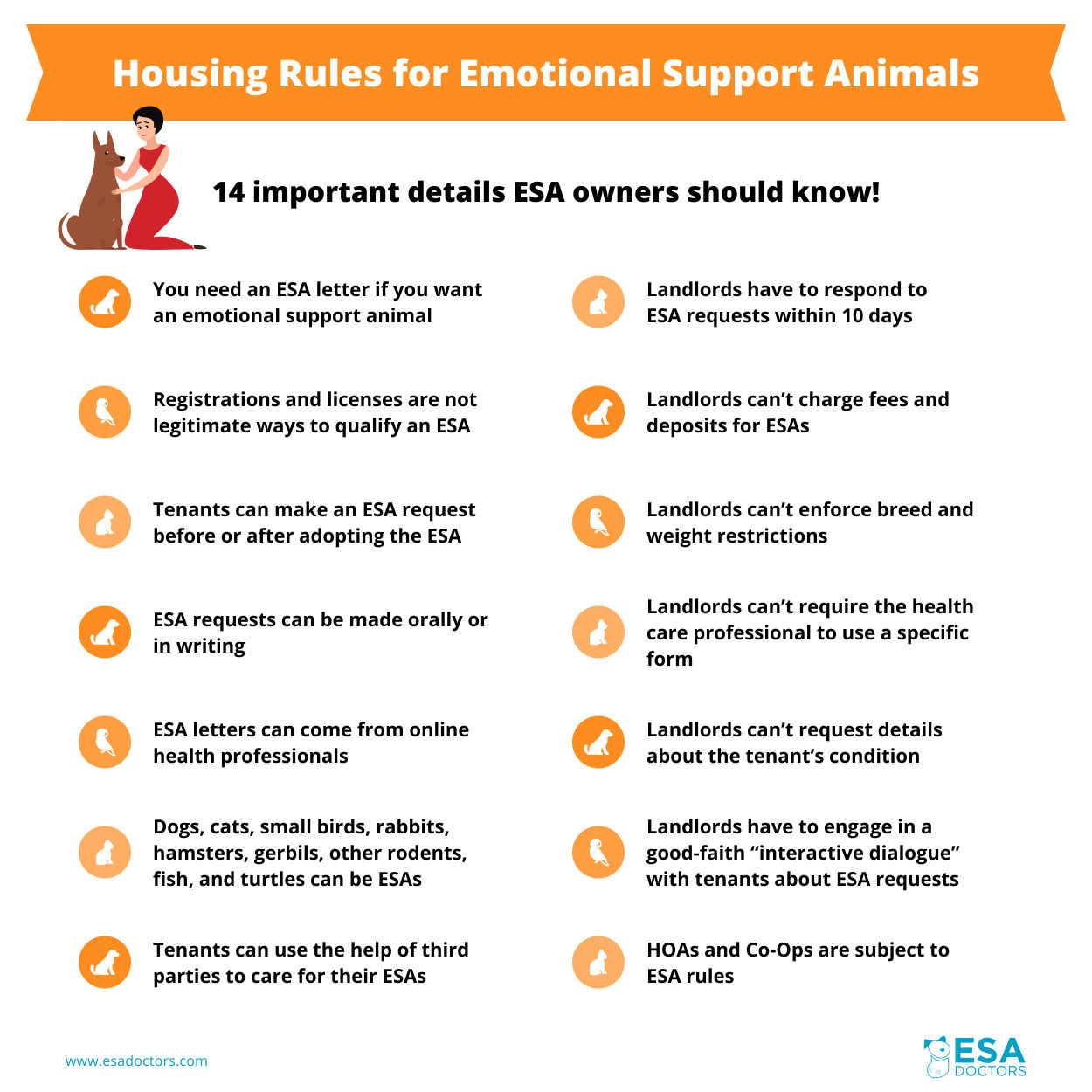
Below is a recap of the important details regarding HUD’s latest rules
If you found this article helpful, you may save the graphic below or share it with a loved one who may be impacted by these rules.




Can an ESA animal be refused by a landlord because the animal is not healthy? A friend of mine has a German Shephard that is spayed but the animal has health issues. The dog tests positive for heartworm, is incontinent and has mange. My friend has applied to live in an apartment. She furnished the future landlord with a copy of her vet’s records on the animal . The landlord wants to deny this particular animal based upon the vet report. Can a landlord deny a specific animal based upon the animal’s health?
Landlords are allowed to deny an ESA if they determine the ESA poses a health or safety risk to others.
My landlord has informed me that they “will not accept” any puppies on the premises, but my ESA will be 10 weeks old when she comes home next month. I have read online that she might be denied on the basis of not being housebroken for the first few weeks, but should this dilemma not count as a restriction on “size”?
(She has decided that any ESA I choose must be “2 years or older, vaccinated, and fully trained”. I can’t imagine she’s allowed to make such arbitrary determinations?)
Thanks
I should note that I have already submitted my ESA letter from my therapist of several years.
I gave my landlord company my ESA paperwork. But now they are asking to contact the Dr & asking where his office is. Do they have the right to do this ??
They can contact the doctor for purposes of simple verification, but cannot make intrusive inquiries about your condition.
There is no age minimum for ESAs under Fair Housing rules.
Do ESA laws change by state? am looking to move out of my current state and from how I am reading Montana’s info on their state website only service animals are eligible to have pet rent waived but because emotional support animals are officially trained they don’t count.
I have tried locating a resource that lists the needed info by state but haven’t had any luck.
Some states have their own rules regarding emotional support animals, but Fair Housing protections for ESAs are federal law. That means they apply to every state.
Thank you for much needed information!
I havr lived in my apartment for two months now. I had just resently informed my landlord that I am going to see if i qualify for an ESA. He is conserned on why i didnt said anything when i moved in. And that he don’t think an animal would be able to live in this small, second story apartment. Can he reject my request because I have been living here for that long already?
Also. If the the ESA is making noise while I am not home and it bothers the LandLord, are they aloud to make me get rid of it or kick me out??
Landlords have to consider your ESA request whenever you submit it. It is common for a tenant to not have an ESA and then later need one. Landlords can reject an ESA if they determine it would pose a safety or health risk. Regarding the ESA making noise, ESAs are expected to behave like any other pet in the building. It would likely have to be a sever nuisance however for a landlord to be able to evict someone.
My landlord has received my ESA letter. But is now requiring my therapist to fill out extra forms asking the the nature of my disability and how the ESA will help it. Before they approve or deny the request? Can they legally deny the request A. And B I’m confused as to if they can’t ask what my disability is . How can they ask about the nature of it.
The latest HUD guidelines do not allow landlords to demand a specific form if the tenant has submitted an valid ESA letter.
I live with my grandparents and My ESA lives with me, but it is a no pet apartment, the landlord is telling my ESA cant stay here because the apartment is not rented under my name. What can I do?
If you are a full time tenant in the apartment you are entitled to Fair Housing rights.
can my coop tell me I can’t exercise or walk my esa on the property?
ESAs should be allowed in common areas where other tenants are allowed to go.
Hi –
My property management hasn’t responded to my ESA accommodation request and it’s been 8 days. I followed up yesterday. If I do not hear from them in 10 days – what are my rights?
We suggest following up with your landlord as soon as possible and reminding them of their Fair Housing obligations.
The apartment building I am trying to sign a lease with worked with a 3rd part pet screening company. I had to submit my pet information, vaccination records and ESA letter through this company. I submitted my ESA letter and they left comments that it did not have enough detail (I have 2 ES animals) so I scheduled another dr. Visit and my doctor (a medical physician) issued me another letter explains my 2 conditions and need for both of my pets as part of my treatment. The company is not saying that they need a verbal confirmation from my physician. By law, a letter is all that is required right? It is on the physicians letterhead with her signature. I think it is unreasonable to expect a busy physician to call a pet screening company to verify that what she already put in a letter is true. Am I correct? By law, it is my understanding that the letter is sufficient
It seems the issue is that you have two ESAs and the letter was not sufficiently detailed in explaining why you need both ESAs. The letter should establish you have a disability-related need for both animals.
Is there any language on how many ESA’s must be allowed? If someone approaches you with two 25lb ESA’s must that be permitted?
Multiple emotional support animals are allowed as long as the tenant’s licensed healthcare professional has recommended each one. The tenant must also be able to keep the animals safely and humanely within their living space.
Can a landlord require the dog to be leashed while on the property?
Fair Housing rules are silent about this, but a landlord can take reasonable steps to ensure the safety and comfort of other tenants. If regular pets are required to be leashed, then the landlord is probably make a reasonable request.
I have my LITTLE dog for 11yrs. I have lived in my apartment for 12yrs and haven’t had any trouble with the dog for 11yrs. A new real estate office took over the apartments and found out I had the dog and told me to get rid of the dog or get out. There were SIX other tenants that had animal also. There is a no animal policies in the lease BUT nobody ever said anything. I was sent a letter by the real estate company to get rid of the dog or get out. I applied for support animal and got through that problem BUT the have refuse to renew my lease. Plus they said that they do not have to tell me the reason why have to leave. I think it is because of the dog. I have to move out I am 71yrs old have high blood pressure and A-Fib. My heath is not well. I don’t have the money to move. Can anybody help me
I have submitted my ESA letter to the manager of the building and the landlord, its been more than 10 days I’ve followed up but still haven’t gotten a response. Can i proceed to get my ESA?
We recommend following up with the landlord and letting them know that per Fair Housing rules they have to respond to your ESA request.