
Getting your pet designated as an emotional support animal is easier than you might think! Despite recent HUD changes in the way ESAs laws are being enforced, designating your pet as an ESA is still straightforward. You just need to train your ESA to respond to the symptom(s) of your disability. You can train your ESA yourself, even if your ESA already naturally responds to the symptoms of your disability. The laws were written to be as expansive as possible to make it easy for people with disabilities to have assistance animals, but companionship alone no longer qualifies an animal as an Emotional Support Animal under federal law. Some states, however, define ESAs as those that provide companionship or emotional support, so it is important to know your state’s laws, as well, because you might qualify for more expansive protections.
Here’s a simple list of emotional support animal requirements:
- Your animal is trained to your symptoms of your physical or mental disability
- You have an ESA letter for housing
- Your animal isn’t a danger to others
- Your animal is a typical household pet
Detailed Requirements for Emotional Support Animals
For an animal to qualify as an ESA, it needs to meet certain requirements that focus both on how the animal helps you and how it behaves around others:
- Performs disability related tasks
Under HUD’s current enforcement approach, the animal must be trained to perform work or tasks directly related to a disability, such as interrupting a panic attack or responding to a practiced cue during distress. Companionship alone does not satisfy that agency enforcement standard. - Doesn’t scare or hurt other people
Your emotional support animal can’t be aggressive or dangerous to others. If your animal growls, bites, or acts in ways that make other residents in your building feel unsafe, it won’t qualify as an ESA. A neighbor’s personal fears or a breed stereotype alone does not establish a direct threat. - Doesn’t break things or make big messes
While all animals might have accidents sometimes, your ESA shouldn’t chew through walls or cause expensive damage to where you live. - Behaves well enough that others aren’t bothered too much
Your animal doesn’t need perfect behavior, but it shouldn’t bark all night, run wild in public spaces, or create problems that would make it very hard for others to live near you. - Is a legal pet where you live
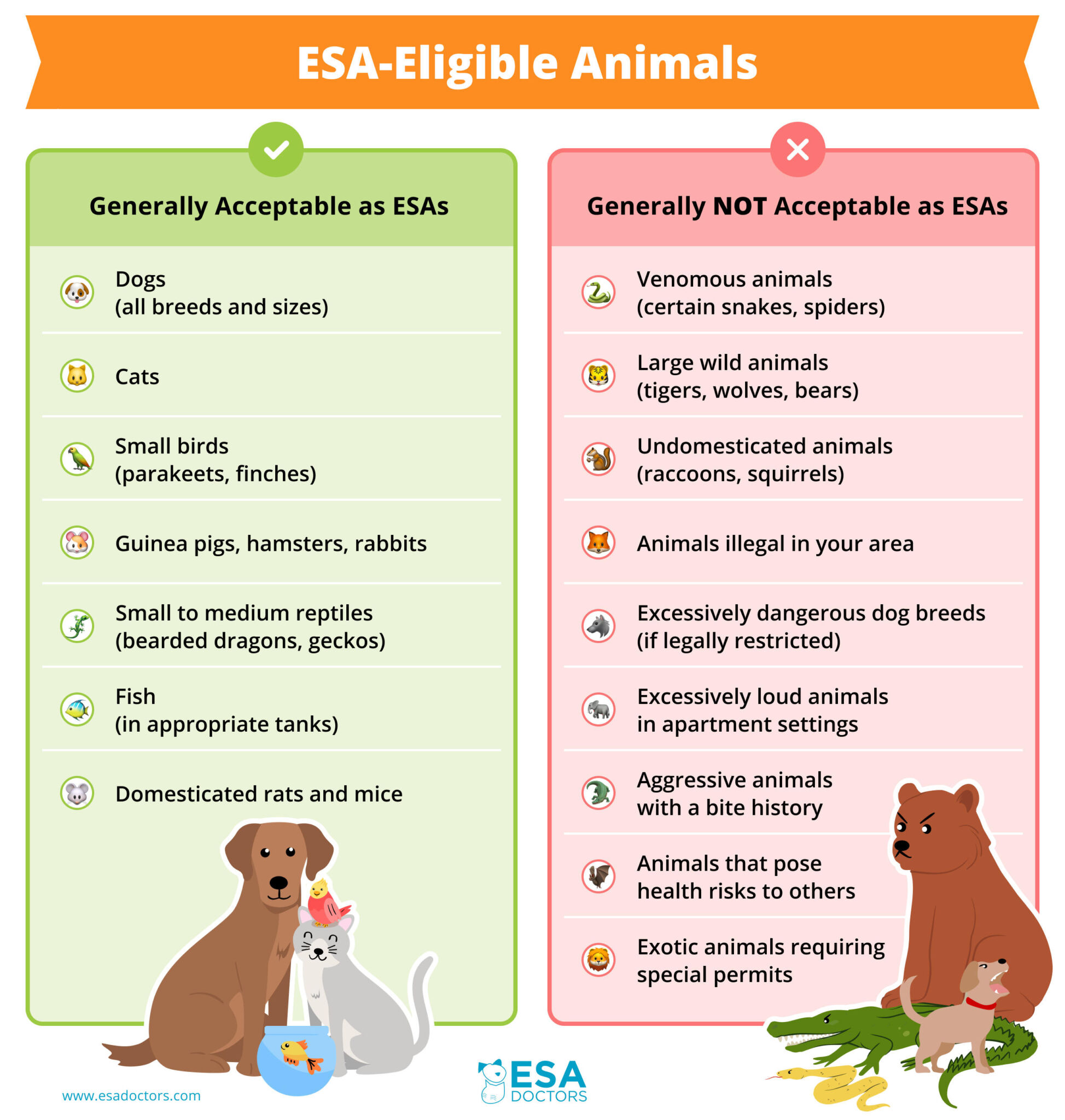
You can’t own an animal that is illegal to own in your city, county, or state. For example, in some places, it’s illegal to keep certain types of snakes or birds. Those animals can’t be ESAs in those areas.
Where These ESA Requirements Come From
The rules about what animals qualify as emotional support animals come from HUD’s housing rules. These guidelines lay out the following:
- What documentation is needed (a letter from a mental health professional)
- What types of animals can qualify (common domestic animals vs. unusual species)
- When a landlord is allowed to deny an ESA request because of the animal’s behavior
HUD’s rules try to find a fair balance between protecting people who truly need animals for mental health support, considering the needs of housing providers and other residents, and ensuring safety and reasonable accommodations for everyone
Common Animals That Make Great ESAs
While almost any domesticated animal can qualify as an emotional support animal, some types are more common than others. Here’s a look at popular ESA choices and why they work well for many people:
Dogs
Dogs are the most common emotional support animals for many good reasons:
- They form strong bonds with their owners
- They can sense mood changes and often respond to distress
- Walking them provides exercise and gets you outdoors
- Many breeds are naturally affectionate and attentive
Example: Brian has depression that sometimes makes it difficult to get out of bed. He has trained Max, his golden retriever, to nudge him repeatedly in response to a specific cue when symptoms make it difficult to begin his day. Their daily walks also provide exercise and routine.
Check out our guide on some of the best dog breeds for emotional support animals.
Cats
Cats make excellent ESAs, especially for people who:
- Live in smaller spaces
- Have less energy for active play
- Enjoy quiet companionship
- Need an animal that’s more independent
Example: Sophia has social anxiety and finds large gatherings overwhelming. Her cat, Luna, comforts her when she returns home stressed from social situations. Luna likewise responds to Sophia’s symptoms and lays on Sophia’s chest or lap, allowing Sophia to pet her fur and listen to her purr. These actions help Sophia’s racing heart slow down. Since cats don’t need walks, Sophia doesn’t have to go outside when she’s feeling particularly anxious.
Small Animals
Many small animals such as guinea pigs, rabbits, rats, and hamsters are not automatically excluded from being emotional support animals. However, under HUD’s current federal enforcement guidance, comfort or companionship alone is not enough: the animal must be individually trained to perform work or tasks related to the person’s disability. Whether a particular animal meets that standard depends on what it has been trained to do. State housing laws may provide additional protections for animals that have not received task training.
Birds
Some birds can learn specific behaviors that help a person respond to symptoms of a disability. For example, Elena has PTSD and sometimes experiences flashbacks. She has trained her cockatiel, Sunny, to perch on her hand when she gives him a particular signal. Focusing on that familiar, practiced interaction helps Elena ground herself in the present. Sunny’s trained response gives Elena a specific way to ground herself during a flashback, illustrating the disability-related assistance HUD’s current enforcement guidance calls for.
Other Animals
Requests involving less common animals, such as reptiles or pot-bellied pigs, require careful, individual consideration. Under HUD’s current enforcement guidance, the animal must be trained to perform work or tasks related to the person’s disability. A request for an unusual animal may also need to explain why that animal is necessary for the particular accommodation sought.

Examples of Animals That Can’t Be ESAs
Not every animal can qualify as an emotional support animal, even if it makes you feel better. Here are some types of animals that typically don’t qualify, with examples of why:
Animals Not Commonly Kept as Household Pets
Wild or exotic animals, such as deer, raccoons, large snakes, or other wild animals cannot be designated as an ESA because they aren’t meant to live with people.
Example: Jamie loved feeding the squirrels in her backyard and wanted an ESA because watching them made her happy. However, wild squirrels aren’t allowed as ESAs because they might bite people, carry diseases, or destroy homes. They’re also not used to living indoors with humans, which would be stressful for them.
Wild animals often carry diseases that can spread to humans, and they typically don’t adapt well to living in homes. This is both a safety issue and an animal welfare concern.
“Barnyard” animals such as horses or chickens may sometimes qualify as a service animal (some exceptions are made under the ADA for miniature horses), or an ESA. However, given the new guidance, it all depends on whether the animal is trained to respond to a symptom of the owner’s disability. Chickens are a prime example of possible ESAs who may be permitted despite local zoning laws banning them. But, animals who are not commonly kept in households have an additional burden of proof that that animal is necessary to respond to a condition of a disability versus an animal that is commonly kept as a household pet.
When an Animal Poses a Safety Risk
A housing provider cannot deny an emotional support animal simply because its breed or species is perceived as dangerous. The provider must assess the particular animal using reliable, objective evidence of a direct threat to others’ health or safety, or a substantial risk of damage to others’ property. For example, a pit bull cannot be rejected solely because it is a pit bull.
Even when there is evidence of a risk, the provider must consider whether reasonable steps could reduce or eliminate it. An animal’s actual behavior or a documented health concern matters; a general fear of that type of animal is not enough.
Disruptive or “Nuisance” Animals
Pets that make too much noise or cause big problems for neighbors might not qualify as ESAs in certain living situations. These animals can be considered “nuisance” animals, and there are many city, county, and state laws, or HOA/COA rules, that prevent people from owning nuisance animals.
Example: Sarah’s parrot can scream loudly for hours at a time. Even though the parrot helps Sarah feel less anxious by giving her company during the day, it might not qualify as an ESA in an apartment building with thin walls because the screaming bothers everyone else and makes it hard for them to sleep or work from home.
While landlords need to make accommodations for ESAs, they don’t have to accept situations that would cause a major disruption to other tenants’ ability to enjoy their homes. There needs to be a balance between your needs and the needs of others in shared living spaces.
Questions You Might Have About ESA Requirements:
“Does my pet need to be trained like a service dog?”
Yes. The Office of Fair Housing and Equal Opportunity states that ESAs must now be trained. This is different from the previous Guidance. Now, ESAs must be trained to respond to a specific symptom(s) of your disability in order to receive federal protections. You can train your ESA yourself, you do not need to have professional training, and your training can encourage behaviors your animal already engages in. For example, if your cat already reacts to you when you have a panic attack, you can use positive reinforcement to encourage and thereby train your cat to continue responding to your panic attacks.
Keep in mind that some states provide protections for ESAs and service animals -in-training, but the federal laws do not provide that protection. So be sure to check your state laws, as well.
“Does my animal need to be a certain age to qualify as an ESA?”
No, there’s no age requirement for an emotional support animal. Both young and older animals can qualify. But again, because training is now required, if an animal is too young to be trained, keep that in mind when timing your request for accommodation.
“Are certain dog breeds disqualified from being ESAs?”
No, emotional support animals aren’t restricted by breed. Any dog breed can qualify as an ESA as long as the individual animal is well-behaved and doesn’t pose a threat to others.
For example, even though Jamie’s apartment building normally has breed restrictions against pit bulls, they had to make an exception for his emotional support dog because breed restrictions don’t apply to legitimate ESAs under fair housing laws.
“Does my animal need a special certification test to be an ESA?”
No, emotional support animals don’t need to pass any certification tests or courses.
“Does my animal need to wear a special vest or ID tag to be identified as an ESA?”
No, emotional support animals are not required to wear special identification. Vests, harnesses, ID tags, or badges are not legally required, though some owners choose to use them.
“Does my animal need to be spayed or neutered to qualify as an ESA?”
No, emotional support animals are not required to be spayed or neutered, though this is often recommended or required by your city, county, or state for health and behavioral reasons.
“Can my animal be disqualified from being an ESA if it barks or makes noise?”
An ESA can potentially be disqualified if it causes substantial disruption that cannot be mitigated, but occasional normal animal noises are generally acceptable. Check out our guide for what to do when your ESA barks.
“Does my ESA need to have regular veterinary check-ups to maintain its status?”
While not legally required for ESA status, regular veterinary care is strongly recommended for your animal’s well-being and may be expected as part of responsible pet ownership.
“If my animal has a minor behavior issue, can it still be an ESA?”
Yes, minor behavior issues don’t disqualify an animal from being an ESA as long as the behavior doesn’t pose a threat to others or cause significant property damage.
For example, Emma’s cat occasionally scratched furniture, which is normal cat behavior. This didn’t prevent the cat from being her ESA. Emma provided scratching posts and regularly trimmed her cat’s claws to minimize damage.
“Can I have more than one ESA, or is there a limit?”
You can have more than one ESA if each animal provides different support for your condition and your mental health professional documents this need in their letter.
For example, Taylor’s therapist documented that both his dog and bird serve as ESAs for his depression in different ways. For example, the dog encourages physical activity while the bird provides distraction by whistling/singing during anxiety attacks. His housing provider had to accommodate both animals as a reasonable accommodation.
“Is my animal disqualified if it hasn’t lived with me for a long time?”
No, there’s no requirement for how long you need to have owned your ESA. A newly adopted animal can immediately become an ESA with proper documentation.
If you want to work with a healthcare professional licensed in your state to see whether you qualify for an ESA letter, check out this helpful resource.

My landlord has threatened to take my emotional support dog away if I’m in the hospital more than 24 ours and take him to the pound. I have people who would come get him if that happens. But now there saying he has to be neutered. He’s always with me me when he’s outside he’s on a leash. And he doesn’t bark or treat stuff up he’s very well behaved. He see other dogs he wants to play he’s very friendly sign people also. I’ve had to cancel getting him neutered 5 times cause no one will take me to the vets them take me to pick him up afterwards. She knows this but I got a letter saying if I didn’t get him neutered shed take him to the pound. There real assholes they don’t follow the fair housing rules they charge us $70 to unplug our toilet and 30 per lightbulb even if we have the light bulbs. They know I’m nearly getting by .. there also raising my rent to 495 in June I pay 450 now. I need help .
Can someone have two ESA’s?
Yes, you can have more than one emotional support animal.
A landlord I’m about to start a new lease with who has informed me my application for the apartment was approved and who was informed in advance about my ESA asked for my letter from my therapist. I have provided it.
Now they are asking for a certificate showing my ESA is certified. What does that even mean? There is no certificate. I received a letter from my licenced mental health professional. They accepted my security deposit and stated if I back out of the apartment I won’t get it back but now they’re saying either I give them the certificate or pay a $500 pet deposit.
What in the world is happening right now. I feel like I’m in the twilight zone. Is this even legal?!!!! They even sent me a picture of a card with a dog’s picture like an ID lol stating ESA on the top of it…… I’m really confused 🤔
The only documentation you need to qualify for an ESA is a letter from a licensed healthcare professional. You absolutely do not need a “certificate”, there is no such thing as an official legally recognized ESA certification program.
Hello, my boyfriend Chris and I have signed a One-year lease for a small rental house we are moving into this weekend, and are moving in with an ESA. We were worried we could not find a home in time for our expected moving-day agreement with our current landlord so we did not disclose we have her. We have gone through so many applications and viewings and each time denied and think it may be because we notified the landlords about our ESA, Chloe. We were told by friends and the research we did prior to applying for housing that we did not have to disclose this information, period, that we had any pets/animals/etc. so we stated we did not have any “pets.” She’s a very well behaved lazy dog and is my boyfriend’s ESA. I am worried our new landlord will have a bad taste in his mouth since we did not tell him prior to signing the lease. I feel awful about it and want to know the proper steps to inform him, I was just worried we would be homeless! :(
At this point we recommend having an honest and open discussion with your landlord about your ESA needs. Under Fair Housing rules, your landlord has to consider your ESA request whenever it comes in. The best approach is always to be friendly and take steps to address any concerns the landlord may have regarding your ESA. Good luck!
Can a 17 year old get an ESA? My parent consents and supports the idea but I’ve read that its only for 18 years and higher? Would it be possible for me to register for an ESA now?
It is possible for minors to qualify for an emotional support animal, but at this time we only assist clients who are 18+.
If I have a Certified Peer support professional with the MHA, can they authorize an ESA?
We’re not sure whether that would qualify as someone who is a licensed healthcare professional. Professionals that issue ESA recommendations are typically licensed therapists, doctors, social workers, nurses and psychiatrists.
Do I have to have my Esa cats vaccinated and do I have to give their shot records to my landlord if requested?
It is not unusual for landlords to make that request.
At what age can a dog be considered and emotional support animal, and what training is required other than the basic commands? Is there a limit on how many ESA’s one person can have?
There is no age requirement for an ESA. An ESA does not require any specific training – they provide support just through their companionship. The number of ESAs you can have depends on what your licensed healthcare professional believes is appropriate for your condition.
Can an untrained, unfixed, unlicensed, unvaccinated pitbull be licensed as an emotional support dog?
Just to clarify, emotional support animals are not “licensed”. The only way to have an official ESA is by possessing a recommendation letter from a licensed healthcare professional. ESAs do not need specialized training to address the owner’s disability, but they should be well-behaved and have basic obedience training. ESAs like all other animals are also subject to licensing requirements for animals generally in the area you live in. Landlords and airlines may also require vaccination records to ensure the animal will not pose a health problem.
Hello. I have a question. I suffer from panic attacks and anxiety, does the animal have to know certain things to be a emotional support animal? my dog Cerberus is still a puppy so I want to train him young.
Emotional support animals, unlike service animals, do not require any special training. However, it is great that you are interested in properly training your dog. All ESA owners should be as responsible as you to ensure their dogs are well behaved wherever they go and are good ambassadors for other ESA owners!
I’ve seen a couple places that say there are no age restrictions on ESA’s but is that written formally anywhere? I’ve been approved for an ESA but my property manager is trying to enforce a policy of no dogs less than one year old (which is their requirement for residents with dogs that are not ESA’s) and I’m not finding formal documentation regarding housing accommodation that talks about age restrictions.
Neither the Fair Housing Act nor guidance from the Department of Housing mentions anything about age requirements. As long as the ESA is not a threat to others, age should not be a relevant consideration.
Do I have to get a letter from a mental health doctor or can I just go see my regular doctor to get the letter?
Physicians are capable of writing ESA letters, but ESA letters generally tend to be from mental health professionals.