

 Legally reviewed by:
  Medically reviewed by:
 As a landlord, homeowner association (HOA), co-op, or other housing provider, you may have received a request from a tenant who wants to live with an emotional support animal (ESA). You, of course, want to comply with the Fair Housing Act and applicable state and local housing laws, while also making sure the request is genuine.
As a landlord, you can verify a tenant’s emotional support animal request by doing the following:
- Making sure the tenant has an ESA letter
- Reading the ESA letter to make sure it says the tenant has a health condition that requires an ESA
- Making sure the letter was written by a licensed healthcare professional
- Making sure their license is active in the state where the tenant resides
The verification process for ESAs does not include:
- Checking a database
- Requesting medical records of examinations
In this article, we’ll further explain how you can verify a tenant’s ESA request while complying with Fair Housing rules.
Note: This article reflects the law as of June 2026. In September 2025, HUD withdrew its prior assistance-animal guidance (FHEO-2020-01 and FHEO-2013-01), and a May 22, 2026 HUD enforcement memo confirmed that withdrawal. The Fair Housing Act itself is unchanged, and many state and local laws continue to protect emotional support animals. Landlords should confirm the rules in the state where the property is located.
What can I ask a tenant to prove they really need an emotional support animal?
The primary document you can ask a tenant for to prove they have an emotional support animal is an ESA letter signed by a licensed healthcare professional. You may separately ask for limited information unrelated to the disability, such as proof that a dog has been vaccinated, but not the tenant’s personal medical history.
You can, however, get reasonable assurances that the tenant’s emotional support animal won’t create safety issues for other tenants. You can ask, for example, if the tenant’s dog has been vaccinated and whether there are any behavioral issues to be aware of.
You’re allowed to have constructive conversations about how to accommodate a tenant’s ESAs as long as you don’t violate the tenant’s right to privacy regarding their health.
If a tenant’s disability or disability-related need for the animal is not readily apparent, the housing provider may request supporting documentation in the form of an ESA letter. Where the disability and the need are obvious or already known, a request for documentation is not appropriate.
ESA Doctors, est. 2015
What type of documentation is valid for an emotional support animal?
The only document valid for an ESA request is an ESA letter from a licensed professional, like one of the following:
- psychiatrists
- psychologists
- social workers
- physician’s assistants
- nurse practitioners
- nurses
- licensed counselors and therapists
Keep in mind that an ESA letter does not have to come from a doctor, and most are not from physicians.
Housing providers are sometimes presented with things like ESA registrations and certificates, identification cards, tags, and other accessories. Be aware that these items are not sufficient to prove that a tenant’s pet is an ESA, and you have the right to ask for an ESA letter instead.
How can I further verify that a tenant’s ESA letter is real?
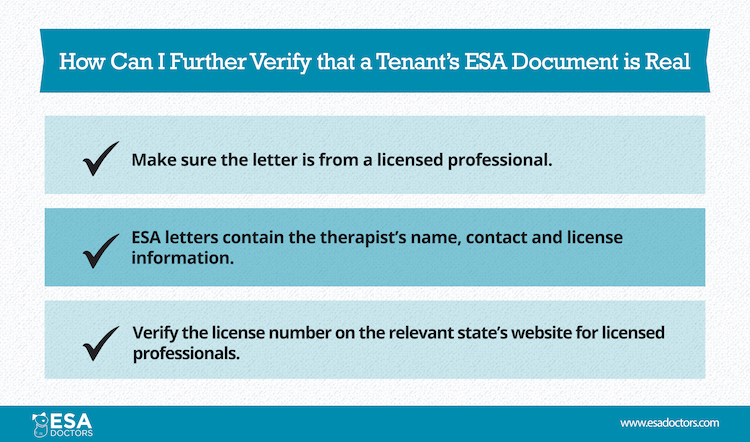
After being given an ESA letter, you might wonder how you can verify that the letter is authentic. The ESA letter should contain the therapist’s name, contact information, and license information.
You can verify the provider’s license number on the licensing website for the state where the tenant resides. The website should tell you whether the therapist is currently licensed.
If, for some reason, you still have doubts, you can try contacting the provider to verify that they wrote the letter. Be mindful, however, that you shouldn’t inquire about the tenant’s mental health history. The provider may also refuse to disclose information due to client confidentiality, in which case you’ll need the tenant’s permission to speak to them.
What can’t I ask regarding a tenant’s emotional support animal?
Under the Fair Housing Act, landlords cannot require the disclosure of details regarding the tenant’s diagnosis or the severity of their disability.
The landlord is also prohibited from requesting medical records.
ESA Doctors, est. 2015
Some landlords make the mistake of denying an ESA letter because they feel it did not sufficiently describe the tenant’s reasons for needing their emotional support animal. That may be a deliberate omission by the therapist since both professional obligations of confidentiality and Fair Housing rules prevent the provider from disclosing too much information about the tenant’s condition.
Historically, asking the tenant what the ESA has been trained to do was considered off-limits because emotional support animals are not required to have specialized training. The reasonable-accommodation obligation still exists under the Fair Housing Act and under many state and local laws, regardless of training, but a landlord’s question about training is no longer treated the same way at the federal enforcement level.
Can I ask the tenant to fill out my own form?
If a tenant has provided a valid ESA letter, you can’t request additional forms, certificates, registrations, or ID cards.
In the past, many landlords tried to have tenants and their healthcare providers fill out additional forms to verify an ESA request. As a general matter under the Fair Housing Act, housing providers should not require a healthcare professional to use a specific form, provide notarized statements, make statements under penalty of perjury, or provide an individual’s diagnosis or other detailed information about a person’s physical or mental impairments.
Finally, keep in mind that the Fair Housing Act is not the only law that applies. Many states and localities have their own fair housing laws, and some provide broader protections for emotional support animals than current federal enforcement does. Always check the requirements in the state and locality where the property is located.




can we ask how long they have seen the tenant? to establish a on-going relationship rather than a questionnaire online?
Great info for essential pet owners.
Thanks for the compliment!