
 Written by:
 Legally reviewed by:
Cats can make wonderful emotional support animals, and many can learn useful behaviors through positive reinforcement. Because cats respond best when they choose to participate, you must first identify something that motivates them. In my experience, food works best. I have had great success with using canned cat food, small pieces of cooked chicken, and canned tuna. I offer soft food on a baby spoon to protect my fingers; the spoon also works great as a target for teaching cues.
Tactile Stimulation
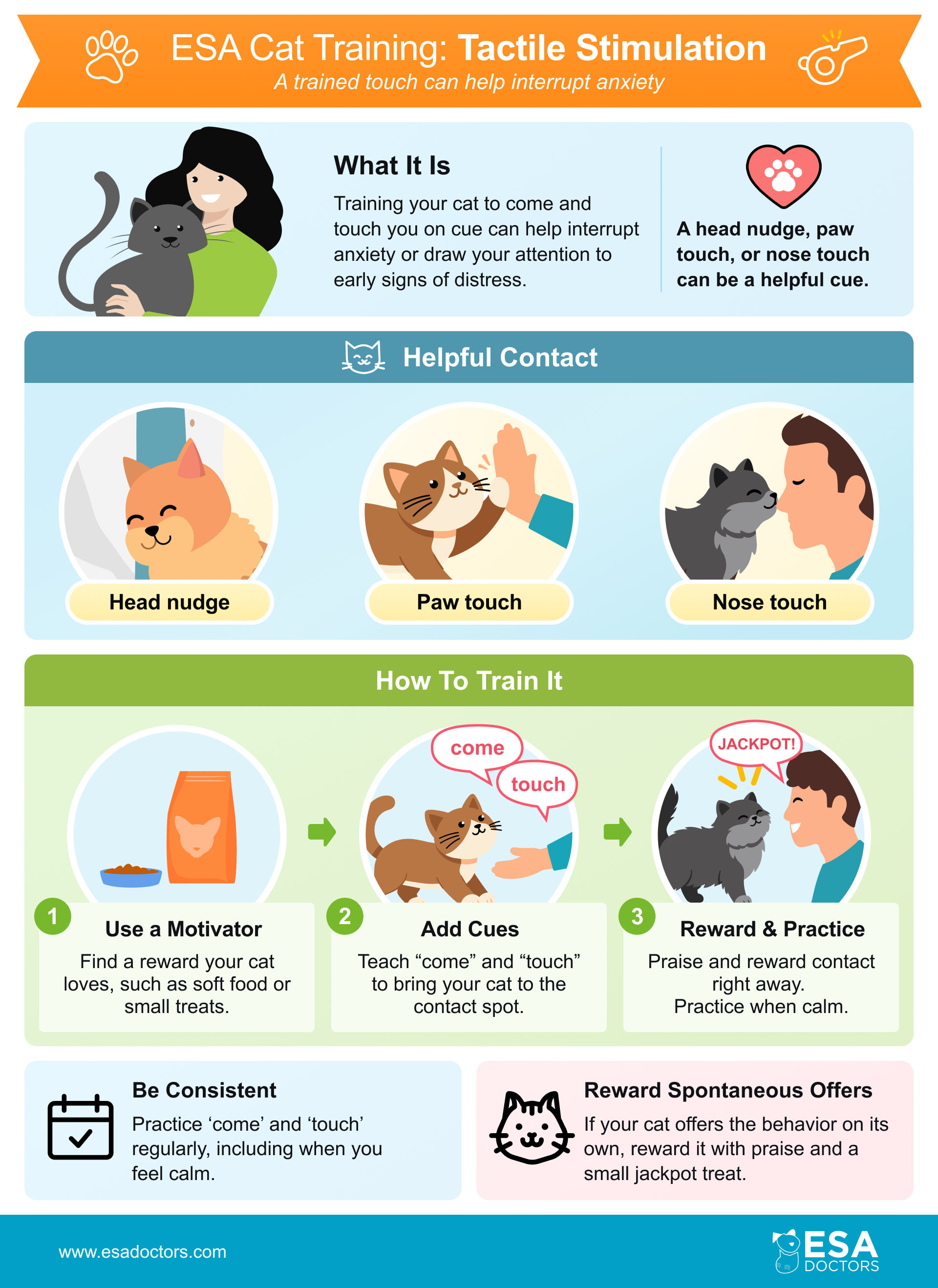
Tactile stimulation can help interrupt an episode of anxiety or draw your attention to early signs of distress. You can train your cat to come and touch your arm with a paw or nose on cue. In my experience, cats like to push against me with their heads, which I call a “head butt.”
Start by teaching your cat to come and touch you on cue. Individual cats have their preferred ways of making contact. Some may sit on you, while others nudge your shoulder. Using consistent “come” and “touch” cues, you can encourage a response in a place that works for both of you.
For example, I teach a cat to come to my side and nudge me with its head or pat me with a paw. As soon as the cat touches me, I praise and reward it. This reinforces the behavior, and it increases the chances it will be repeated. With consistent practice, I have seen cats begin offering their behavior without a cue, possibly in response to changes in my behavior or scent. Cats have an excellent sense of smell, although we cannot assume they will reliably detect an impending anxiety episode, but, with proper training, they can respond to your symptoms.
Scent may influence feline behavior, but it is better to build a clear response through consistent cues and rewards than to depend on a cat to recognize a particular mood or scent. Practice “come” and “touch” cues regularly, including when you are calm. If your cat begins offering the behavior without prompting, reward it with a small “jackpot” of its favorite treats and plenty of praise. My cats prefer canned tuna or canned cat food.
Pressure Therapy
Tactile stimulation can also be developed into pressure therapy. First, decide where you want your cat to apply pressure: your chest, lap, legs, or feet. In my experience, the most effective area is on the chest. The cat’s warmth and purr help settle anxiety and fear.
Start by teaching your cat to come to your chest (or other area of the body) and lie down on cue. If your cat already enjoys resting on your lap or chest, you can build on that natural behavior. Begin with “come,” then “sit,” and finally, “lie down.”
I have found that if I cover up with a soft blanket, my cats are often drawn to lie on it. This allows me to capture the behavior as it occurs, eventually adding a cue once my cat understands what I’m asking.

Behavior to Interrupt Anxiety, Dissociation or Similar States
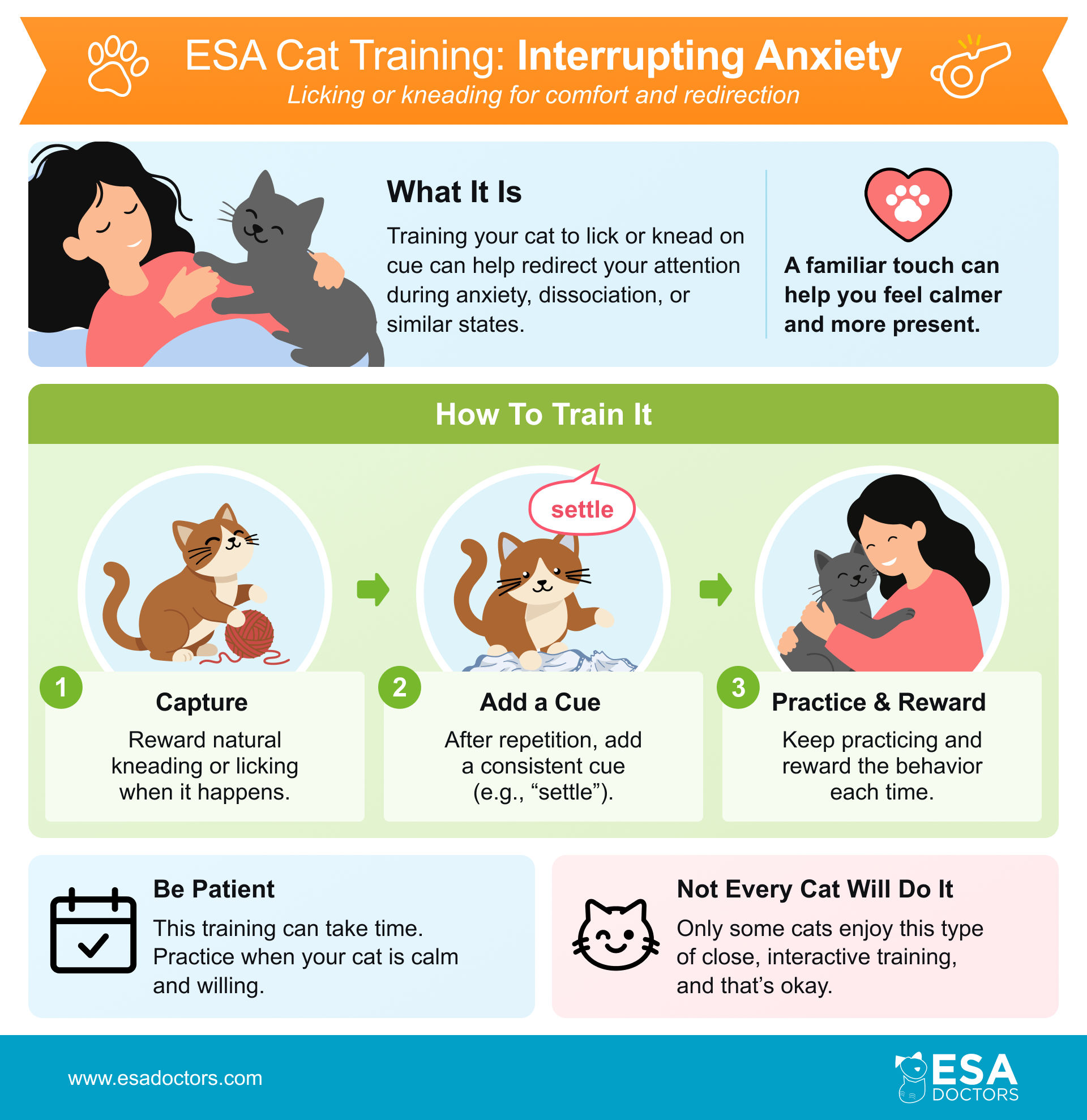
If your cat notices signs of distress, a familiar touch or other trained behavior may help redirect your attention. Some cats can learn to knead or lick on cue when those behaviors are rewarded. The process begins by “capturing” a behavior your cat offers naturally and rewarding it. You can then shape the behavior through repetition.
Because your cat needs to offer the behavior willingly, this training may take time. Watch for moments when your cat is relaxed and naturally kneads or licks, then reward the behavior promptly. As the association strengthens, your cat may offer it more often. You can then add a consistent cue, such as “top” or “settle,” while patting the spot where you want your cat to rest. Be patient. Some cats learn the cue readily, while others do not enjoy this kind of contact.
In my experience, only some cats enjoy this type of close, interactive training, so do not be disappointed if yours is not interested in these behaviors. Success takes patience and a cat that enjoys participating. Starting when a cat is young can help, but adult cats can learn too.
Reminding You to Take Medication
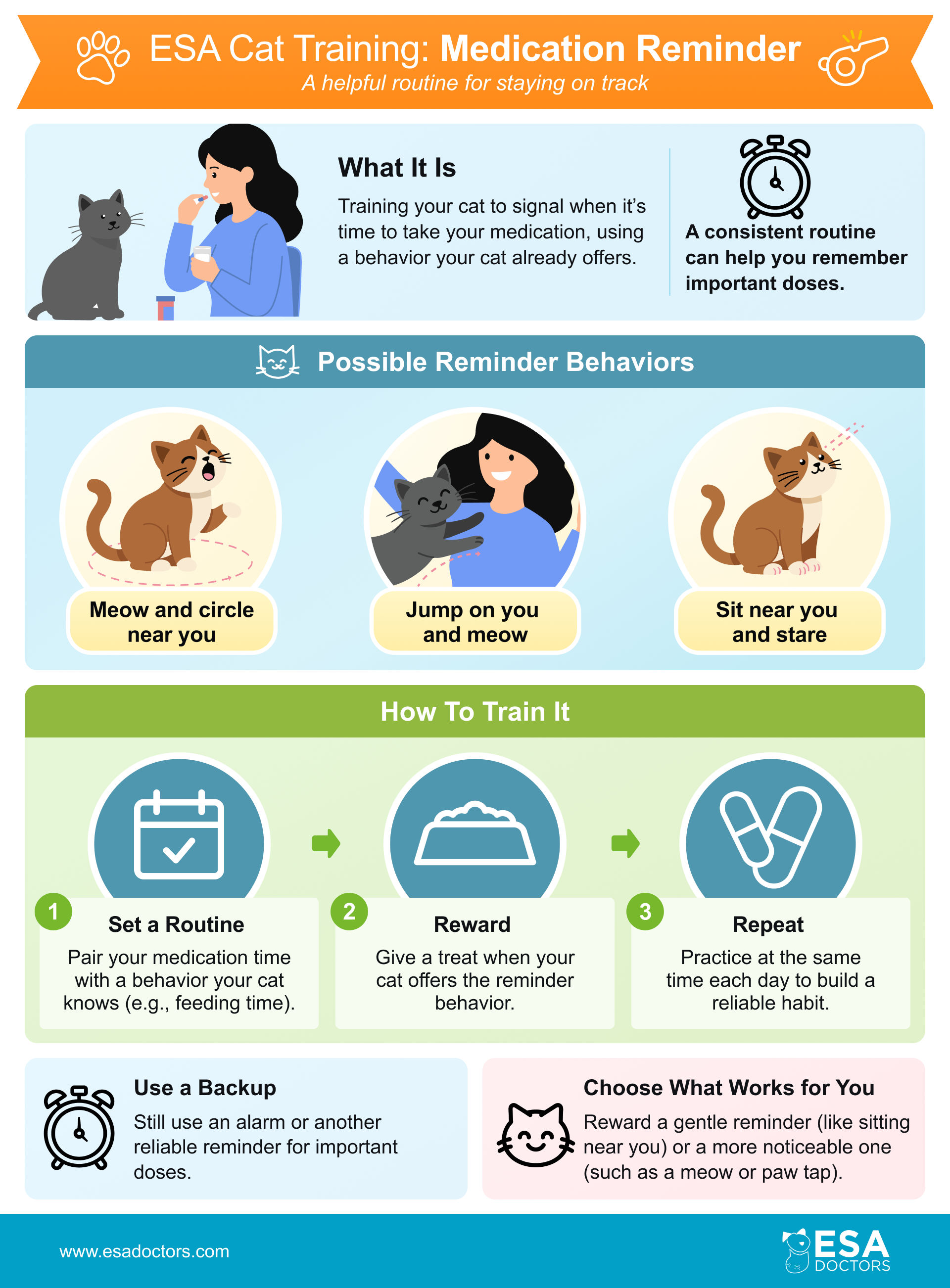
Just as cats remind their owners when it is feeding time, some can also be taught to remind you that it is time to take your medication. Cats may signal that they are expecting something in several ways:
- Meow loudly while walking in circles near you.
- Jump on you and meow at your face.
- Sit on you, or near you, and stare at you.
- Knock objects off a surface, although this is not a behavior to encourage.
Because medication is often taken on a regular schedule, you can pair that routine with one your cat already knows. Your rewards will help shape the type of reminder your cat offers. If you prefer a gentle prompt, reward a quiet behavior such as sitting nearby and looking at you. If you need something more noticeable, you might reward a meow or a gentle paw tap. Choose a behavior that is comfortable for both of you.
My cats are accustomed to eating at specific times of day, and their meows often remind me that it is time for my own routine. They begin circling and meowing several minutes before feeding time, and I have paired their bedtime routine with the time I take medication. I still recommend using an alarm or another reliable reminder for important doses.
You can shape this behavior by giving your cat a treat at the same time each day that you take your medication. After several days of consistent practice, your cat may begin expecting that reward at the same time. When your cat offers the behavior you want, such as sitting beside you and meowing, give the treat, then take your medication. Over time, this can build a useful routine for you both.
A Note About This Training Guide
This article is based on the personal experience and professional expertise of animal trainer Miriam Fields-Babineau and is intended for educational purposes only. Training results vary by cat, and not all cats can learn the behaviors described. Claims regarding cats’ ability to detect changes in human emotions, scent, or physiological states have not been conclusively established by scientific research. The information provided is not a substitute for professional medical or animal behavior advice.
Does your cat provide emotional support?
Work with a licensed professional to get a legit ESA letter in your state.




Leave a Comment